Side-by-side or overlay PDF diff driven by one engine that reads each file into a structured model — text, vector geometry, images, form fields, annotations — and compares the models. Moves show as moves, edits show only where they happened, and any PDF type works without picking a mode.
Open a STEP / STP part and it measures itself — volume, thinnest wall, draft and undercut checks on load, plus hole detection with a BOM. Measure, section, export STL. Rust + WASM B-rep kernel, runs in your browser.
Whole cow milk, raw or thermised but never pasteurised, is soured with lactic bacteria and renneted, then left to curdle for 12–24 hours in small basins. The soft curd is moulded without pre-draining or pressing, drains at least 14 hours, is dry-salted, and then dries and ripens until a thin white to grey-blue rind forms, at least 10 days after renneting.
lactic bacteria, which may be supplemented with ripening flora (yeasts, moulds and Geotrichum)
Total time across the recorded steps: 44 h – 3.3 days
Start
Drag the bar or press Play
What changes:Starting material: whole cow milk, raw or thermised, never pasteurised
Step 1 of 6
Collect whole milk and optionally pre-ripen it cold
Time
0 min – 24 h
Set
Temperature
8–12 °C
Set
Salt
None given
Acidity
Not documented
Which microbes the steps name, step by step
Lactic acid bacteria
Geotrichum
Yeasts
Moulds
Output: whole cow milk.
Flavour
Not documented
Texture
Not documented
Colour
white
Microbes at work in this step
milk is used raw or thermised
Method
Measured measured in a studySet fixed by a specification or tested recipeReported one source reports itTypical a general value, not sourced for this fermentUnconfirmed not yet checked against a source
At a glance
Whole cow milk, raw or thermised but never pasteurised, is soured with lactic bacteria and renneted, then left to curdle for 12–24 hours in small basins. The soft curd is moulded without pre-draining or pressing, drains at least 14 hours, is dry-salted, and then dries and ripens until a thin white to grey-blue rind forms, at least 10 days after renneting. Made in 6 steps over 44 h – 3.3 days. The longest step, collect whole milk and optionally pre-ripen it cold, takes 0 min – 24 h (Ministère de l'agriculture 2014) and runs at 8–12 °C (Ministère de l'agriculture 2014). Lactic bacteria added to sour the milk and Geotrichum, with yeasts and moulds, allowed as optional ripening flora do most of the fermenting.
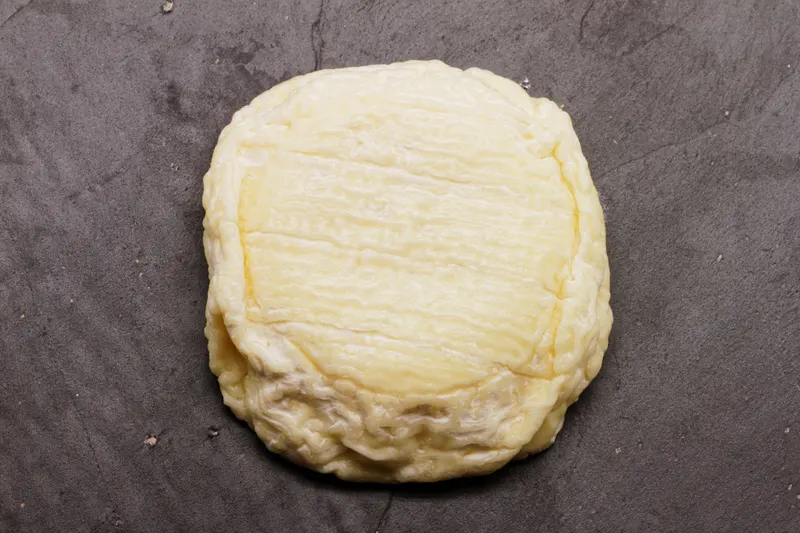
Saint-Marcellin is a cow-milk cheese made the way small lactic goat cheeses are made, with a 12–24 hour acid set and no pressing. Pasteurisation is banned, and the curd must not be pre-drained. Its thin rind is covered with white, beige to grey-blue moulds.
Rind
Thin, sometimes wrinkled; white, beige to grey-blue moulds
Size
65–80 mm diameter, 20–25 mm high, ≥80 g
Earliest sale
At least 10 days after renneting
Styles
Sec has more than 44 % dry matter; moelleux more than 40 %
The milk is raw or thermised, never pasteurised, and the specification lets the cheese be sold no sooner than 10 days after renneting. The CDC says raw-milk products can expose people to germs such as Listeria, E. coli, Brucella and Salmonella. ANSES advises pregnant women, young children, people over 65 and people with weak immunity to avoid raw-milk cheeses other than cooked pressed ones such as Gruyère or Comté. A soft cheese like this one is not in that exception.
The specification says the cheese was dried in hanging baskets called tommiers, sometimes in walnut-drying sheds. It says small farm tommes took the name Saint-Marcellin as early as the 15th century, from the main market of the time, but that the name only became systematic in the 19th century.