Side-by-side or overlay PDF diff driven by one engine that reads each file into a structured model — text, vector geometry, images, form fields, annotations — and compares the models. Moves show as moves, edits show only where they happened, and any PDF type works without picking a mode.
Open a STEP / STP part and it measures itself — volume, thinnest wall, draft and undercut checks on load, plus hole detection with a BOM. Measure, section, export STL. Rust + WASM B-rep kernel, runs in your browser.
Raw whole goat milk is soured with whey from a previous curdling or a native lactic starter for 2–24 hours, then set with kid rennet at 18–25 °C. It curdles slowly for 18–24 hours to a firm lactic curd, which is ladled whole into small moulds, drained 20–24 hours, dry-salted on both faces and ripened at least 8 days, growing an ivory, white or blue mould coat.
No fixed amounts recordedThe specification fixes limits, not a recipe; the only dose it gives is the lactic starter, at most 3% of the milk volume. A finished cheese is a disc 4.2–5 cm across.
Raw whole goat milk, not standardised
Only filtering and warming to 25 °C at most are allowed[cdc-2022]
Whey from a previous curdling, or a native lactic starter
A starter grown in whole goat milk may make up at most 3% of the milk volume; commercial cultures only after an accident or restart[cdc-2022][eu-am02]
whey from a previous curdling, or a native lactic starter from the producers' group bank
Total time across the recorded steps: 2.1 days – 4 days
Start
Drag the bar or press Play
What changes:Whey from the last batch goes into the raw goat milk and starts to sour it
Step 1 of 7
Sour the raw milk
Time
2–24 h
Set
Temperature
Not documented
Salt
None given
Acidity
Not documented
Dairies may use milk of up to four milkings, seeded within 48 hours of the oldest; farms use the last two milkings at most.
Flavour
Not documented
Texture
Not documented
Colour
Not documented
Microbes at work in this step
Lactic bacteria from the whey or native starter begin to sour the milk.
Method
Measured measured in a studySet fixed by a specification or tested recipeReported one source reports itTypical a general value, not sourced for this fermentUnconfirmed not yet checked against a source
At a glance
Raw whole goat milk is soured with whey from a previous curdling or a native lactic starter for 2–24 hours, then set with kid rennet at 18–25 °C. It curdles slowly for 18–24 hours to a firm lactic curd, which is ladled whole into small moulds, drained 20–24 hours, dry-salted on both faces and ripened at least 8 days, growing an ivory, white or blue mould coat. Made in 7 steps over 2.1 days – 4 days. The longest step, sour the raw milk, takes 2–24 h (INAO 2022).
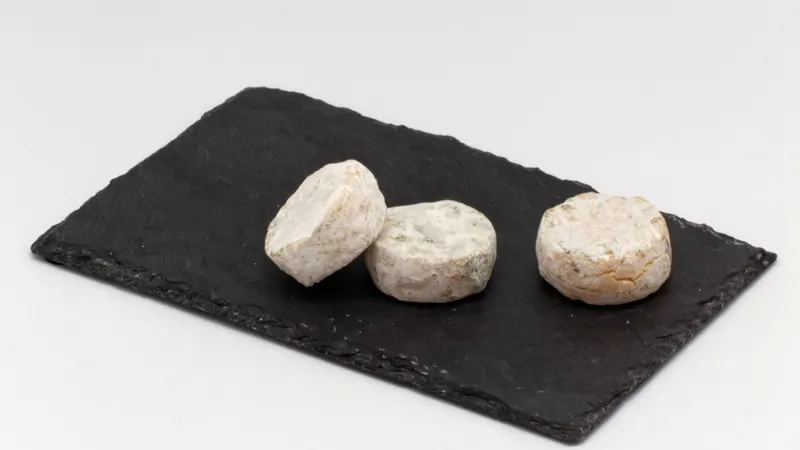
A small lactic goat cheese, soured with whey or native Pilat starters and kid rennet, ladled uncut and ready after only 8 days. Its small mould was chosen to set it apart from the farms' cow cheeses.
Ripening
At least 8 days in total from unmoulding, counting airing, drying and ripening proper
Rind
Surface mould flora, ivory, white or blue
Size
Small disc 4.2–5 cm across and 1.9–2.4 cm high; at least 30 g when aged longer
Composition
At least 40 g fat per 100 g dry matter; dry matter at least 40 g per 100 g
Made from raw milk. The specification sets whey acidity at pH 4.2–4.6 at the end of curdling, forbids freezing at any stage, and requires storage at 2 °C or above after ripening.
Goats spread in the drier parts of the Pilat from the 18th century. Farms ate their cow cheese and sold the more valuable goat cheese in nearby Lyon and Saint-Étienne, which suited a small cheese that dried and ripened fast. The cheese has a reputation of more than a century.