Side-by-side or overlay PDF diff driven by one engine that reads each file into a structured model — text, vector geometry, images, form fields, annotations — and compares the models. Moves show as moves, edits show only where they happened, and any PDF type works without picking a mode.
Open a STEP / STP part and it measures itself — volume, thinnest wall, draft and undercut checks on load, plus hole detection with a BOM. Measure, section, export STL. Rust + WASM B-rep kernel, runs in your browser.
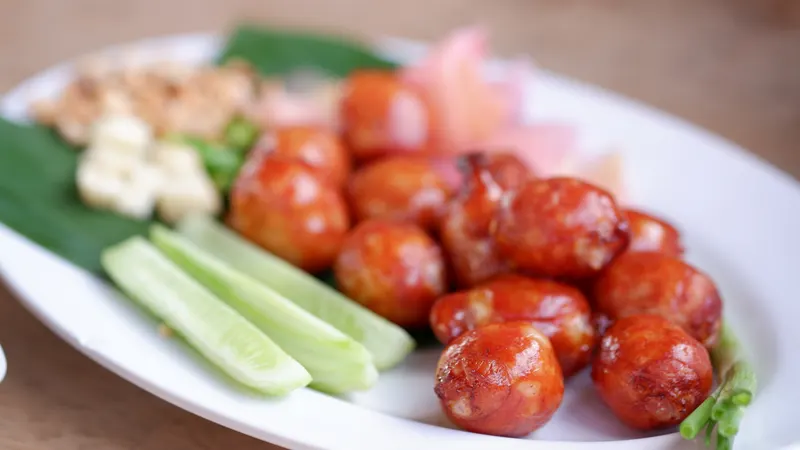
Minced pork and fat are mixed with cooked rice, garlic, salt and pepper, stuffed into pig intestine and tied into links. The links hang at room temperature for 2–3 days while lactic bacteria sour them, and they are grilled before eating.
Amounts from a sourceThe control recipe of one university study, after a Thai meat-processing text; seasonings in g per kg of meat mix. Home recipes vary.
Total time across the recorded steps: 2 days – 3 days
Start
Drag the bar or press Play
What changes:Pork, fat, cooked rice, garlic and salt are mixed together
Step 1 of 4
Mix pork, fat, rice, garlic and seasoning
Time
Not documented
Temperature
Not documented
Salt
None given
Acidity
Not documented
Which microbes the steps name, step by step
Lactic acid bacteria
Rind, when used, is boiled and shredded first. Output: sausage mix.
Flavour
Not documented
Texture
Not documented
Colour
Not documented
Microbes at work in this step
Not documented for this step.
Method
Measured measured in a studySet fixed by a specification or tested recipeReported one source reports itTypical a general value, not sourced for this fermentUnconfirmed not yet checked against a source
At a glance
Minced pork and fat are mixed with cooked rice, garlic, salt and pepper, stuffed into pig intestine and tied into links. The links hang at room temperature for 2–3 days while lactic bacteria sour them, and they are grilled before eating. Made in 4 steps over 2 days – 3 days. The longest step, hang at room temperature to sour, takes 2–3 days (JIRCAS 1995) and runs at 30–34 °C (Sorapukdee S 2019). Lactic acid bacteria and Lactobacillus spp. and Streptococcus faecalis do most of the fermenting.
Sai krok Isan has much more fat than naem (30 % fat or less in the finished sausage against 8 % or less) and is stuffed into hog casing and hung, while naem is lean pork with rind packed tight in plastic or leaves.
Reduced-fat sausage with konjac gelIn one study, swapping half the back fat (15 % of the mix) for konjac gel cut fat by 46 % and scored higher than the control for sourness and overall acceptability.
Safety
In one study the pH fell to about 4.4–4.9 within 3 days, but water activity stayed near 0.97–0.98, so the acid is the main hurdle. In that study, whose sausages held nitrite, S. aureus was at 1–2 log CFU/g in the fresh mix. Salmonella, S. aureus and E. coli were below detection in all finished products tested; that does not cover a home batch, and the paper reports no toxin test. The 15 g/kg dose suits only a curing salt of 0.90 % sodium nitrite, which the paper calls prague powder. Many commercial cures hold 6.25 % nitrite, about seven times as much, so the same weight of one would be an overdose, and nitrite overdoses can be harmful. Work out the dose for the cure in hand. Grill the sausage right through, to at least 71 °C for ground meat. Curing, drying or smoking alone does not reliably kill Trichinella worms in pork. Washington State University Extension warns, of dry sausages, that S. aureus toxin can form if fermentation is not rigidly controlled, and its semi-dry method calls for a starter culture and careful temperature control. These links hang at about 32 °C, and the recipe lists no starter culture. No source we read says grilling removes that toxin.
Hazards the sources name: Salmonella spp., S. aureus and E. coli (below detection in all finished products tested in one study; S. aureus was at 1–2 log CFU/g in the fresh mix).
Sorapukdee and colleagues describe it as a traditional fermented sausage originating in northeastern Thailand and now widely eaten in various parts of Thailand.
Starter
The sources we found do not say how its fermentation begins.