Side-by-side or overlay PDF diff driven by one engine that reads each file into a structured model — text, vector geometry, images, form fields, annotations — and compares the models. Moves show as moves, edits show only where they happened, and any PDF type works without picking a mode.
Open a STEP / STP part and it measures itself — volume, thinnest wall, draft and undercut checks on load, plus hole detection with a BOM. Measure, section, export STL. Rust + WASM B-rep kernel, runs in your browser.
Raw milk from Serrana goats is set with animal rennet, and curdling must take place within 40–60 minutes; the curds are then strained slowly. The cheese ripens at least 60 days, or 90 days for the harder Velho, at 5–12 °C and 70–85 % relative humidity.
For coating the Velho, which turns the rind red[oj-2012]
Starter
In a 2024 study of seven artisanal Transmontano cheeses, the authors say starter cultures and rennet supported the fermentation and coagulation.
Total time across the recorded steps: 2 months
Start
Drag the bar or press Play
What changes:Starting material: raw milk from Serrana goats, pH 6.5 to 6.9
Step 1 of 4
Start with raw Serrana goat milk
Time
Not documented
Temperature
Not documented
Salt
None given
Acidity
Not documented
Which microbes the steps name, step by step
Lactococcus
Streptococcus
Lactobacillus
Output: raw goat milk.
Flavour
Not documented
Texture
Not documented
Colour
Not documented
Microbes at work in this step
Not documented for this step.
Method
Measured measured in a studySet fixed by a specification or tested recipeReported one source reports itTypical a general value, not sourced for this fermentUnconfirmed not yet checked against a source
At a glance
Raw milk from Serrana goats is set with animal rennet, and curdling must take place within 40–60 minutes; the curds are then strained slowly. The cheese ripens at least 60 days, or 90 days for the harder Velho, at 5–12 °C and 70–85 % relative humidity. Made in 4 steps over 2 months. The longest step, ripen, takes at least 2 months (European Commission 2012) and runs at 5–12 °C (European Commission 2012). Lactococcus, Streptococcus and Lactobacillus does most of the fermenting.
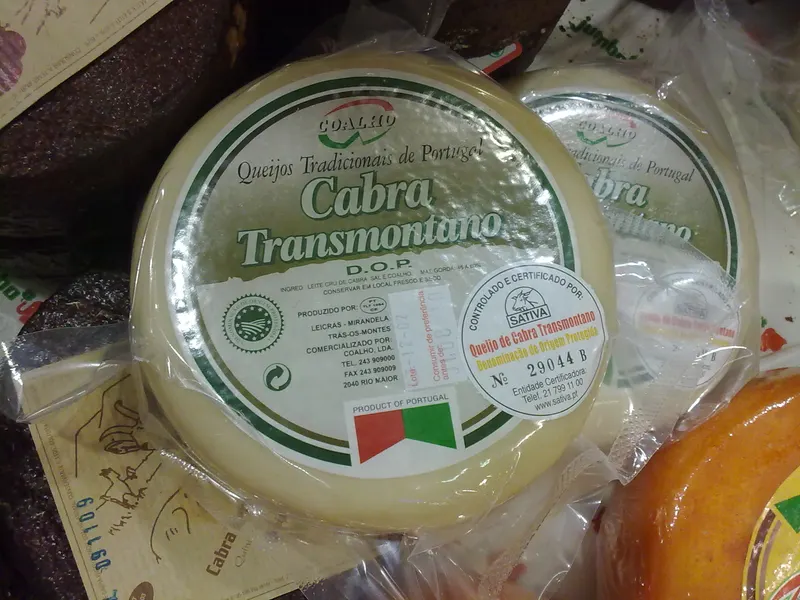
It is made only from the raw milk of one goat breed, the Serrana, set with animal rennet, where Castelo Branco is set with plant rennet. The Velho may be coated in olive oil and paprika.
Milk
Raw milk from Serrana goats only
Composition
Fat 35–55 % of dry matter; moisture 27–37 % (25–35 % for Velho)
Size
Flat cylinder, 6–12 cm or 12–19 cm across, 3–6 cm high; 0.3–0.6 kg or 0.6–0.9 kg
Queijo de Cabra TransmontanoRipened at least 60 days; semi-hard; white rind.
Queijo de Cabra Transmontano VelhoRipened at least 90 days; hard to extra-hard; may be coated with olive oil and paprika.
Safety
Made from raw milk; the specification requires at least 60 days of ripening, or 90 days for Velho, at 5–12 °C and 70–85 % relative humidity. ANSES advises pregnant women, young children, people over 65 and people with weak immunity not to eat raw-milk cheeses other than pressed cooked ones such as Gruyère, because of Listeria, Salmonella and Shiga-toxin E. coli.
The cooperative of Serrana goat milk producers at Mirandela (LEI CRAS) filed the application for the name, received by the Commission on 22 November 1995. The PDO was registered by Commission Regulation (EC) No 1263/96 of 1996. An amendment application published on 9 June 2012 added the Velho type, allowed semi-hard cheeses, set the 40–60 minute curdling time and extended the area to Alijó, Vimioso and part of Bragança; Regulation (EU) No 436/2013 of 7 May 2013 approved it.