Side-by-side or overlay PDF diff driven by one engine that reads each file into a structured model — text, vector geometry, images, form fields, annotations — and compares the models. Moves show as moves, edits show only where they happened, and any PDF type works without picking a mode.
Open a STEP / STP part and it measures itself — volume, thinnest wall, draft and undercut checks on load, plus hole detection with a BOM. Measure, section, export STL. Rust + WASM B-rep kernel, runs in your browser.
Whole ewe milk is set with rennet at 28–35 °C, cut to grains of 1 cm or less and stirred while warmed to no more than 44 °C. The pressed wheels are salted dry or in brine and ripened at 6–15 °C for at least 80 days (120 days for large wheels), with rinds turned and brushed.
Dry or in brine of at most 330 g per litre[ossau-fiche]
Starter
commercial lactic starter or none (raw-milk flora)
Total time across the recorded steps: 2.7 months
Start
Drag the bar or press Play
What changes:Starting material: whole ewe milk from the western Pyrenees
Step 1 of 6
Collect whole ewe milk
Time
up to 2 days
Set
Temperature
Not documented
Salt
None given
Acidity
Not documented
Which microbes the steps name, step by step
Lactic acid bacteria
Lactococcus lactis
Lactobacillus paracasei
Lactobacilli
Output: whole ewe milk.
Flavour
Not documented
Texture
Not documented
Colour
white
Microbes at work in this step
on farms the raw milk brings its own lactic acid bacteria (up to ten species per milk in a study of farm cheeses)
Method
Measured measured in a studySet fixed by a specification or tested recipeReported one source reports itTypical a general value, not sourced for this fermentUnconfirmed not yet checked against a source
At a glance
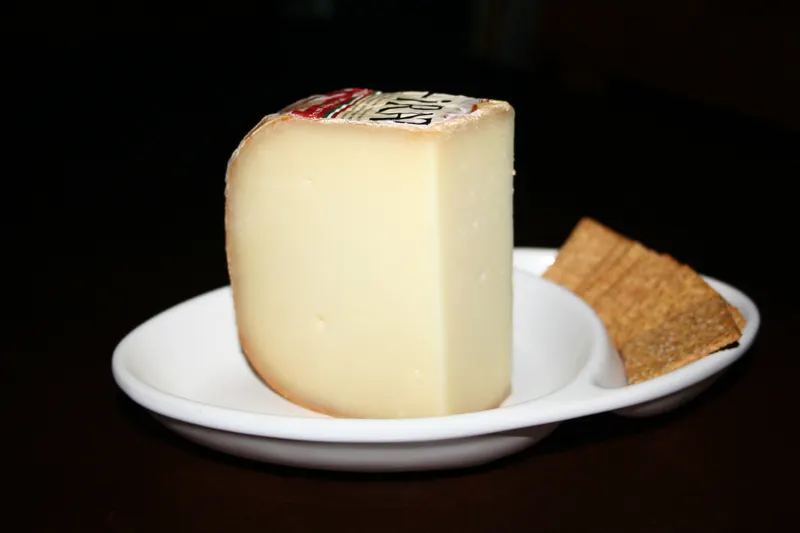
Whole ewe milk is set with rennet at 28–35 °C, cut to grains of 1 cm or less and stirred while warmed to no more than 44 °C. The pressed wheels are salted dry or in brine and ripened at 6–15 °C for at least 80 days (120 days for large wheels), with rinds turned and brushed. Made in 6 steps over 2.7 months. The longest step, ripen, turning and brushing, takes at least 2.6 months (Syndicat AOP Ossau-Iraty 2018) and runs at 6–15 °C (Syndicat AOP Ossau-Iraty 2018). Lactococcus lactis, the most numerous lactic bacterium whatever the milk or starter and Lactobacillus paracasei, found in all the farm cheeses studied do most of the fermenting.
Ossau-Iraty is a pressed but uncooked ewe cheese; the curd is warmed to no more than 44 °C. No cheese is made in September and October, and cheese made on summer pastures can carry a special mark. The rind may be brushed with red pepper purée.
Milk
Whole ewe milk; raw for farm cheese; heat treatment allowed only in dairies
Ripening
At least 80 days (small format) or 120 days (large format) at 6–15 °C
Composition
Fat at least 50 % of dry matter; dry matter at least 58 %
FermierRaw milk only; renneted within 40 h of the oldest milking.
EstiveMade daily from raw milk in the shepherd's hut on summer pasture, renneted within 24 h.
Safety
Farm cheese is made from raw milk. ANSES, the French food safety agency, says Listeria and enterohaemorrhagic E. coli in raw-milk cheeses can kill. It advises pregnant women, people with weak immunity, people over 65 and young children to avoid raw-milk cheeses, except cooked pressed ones such as Gruyère or Comté. Ossau-Iraty is pressed but uncooked, so that exception does not cover its raw-milk wheels.
The 1995 application summary says the region has traces of a farming and herding system from the Neolithic, that Latin authors mention ewe's-milk cheeses sold in the markets of Toulouse, and that fourteenth-century sharecropping contracts and early fifteenth-century notarial documents show ewe's-milk cheese was made there. The appellation was recognised in France in 1980, and the name was entered in the EU register of protected designations of origin by Commission Regulation (EC) No 1107/96 of 12 June 1996.