Side-by-side or overlay PDF diff driven by one engine that reads each file into a structured model — text, vector geometry, images, form fields, annotations — and compares the models. Moves show as moves, edits show only where they happened, and any PDF type works without picking a mode.
Open a STEP / STP part and it measures itself — volume, thinnest wall, draft and undercut checks on load, plus hole detection with a BOM. Measure, section, export STL. Rust + WASM B-rep kernel, runs in your browser.
Vegetables from Nara City and all of Nara Prefecture, Japan
Narazuke奈良漬
Narazuke is vegetables, above all shirouri melon, first soaked in salt and then buried again and again in sake lees, for anything from three months to a year and a half. Salt leaves the vegetable while alcohol and flavour go in, and in two Nara factories an ethanol-loving lactic bacterium ferments it as it turns dark amber.
No fixed amounts recordedFactory and shop practice with no published batch recipe. The lab test mixed 20 g of salted or part-made vegetable with 20 g of aged sake lees.
Richer in flavour than new lees and over 8 % ethanol; lees from the later embeddings are reused for the earlier ones in the next batch[yoshioka2025]
Starter
other: the study predicts the lactic bacterium comes from the factory air or from the sake lees of the previous batch
Total time across the recorded steps: 7.1 months – 22 months
Start
Drag the bar or press Play
What changes:Melons and other vegetables soak in saturated brine and lose water
Step 1 of 4
Soak the vegetables in saturated salt water
Time
2 months
Reported
Temperature
Not documented
Salt
None given
Acidity
Not documented
Which microbes the steps name, step by step
Zygosaccharomyces
F. fructivorans
Output: salted vegetables.
Flavour
Not documented
Texture
Not documented
Colour
Not documented
Microbes at work in this step
Zygosaccharomyces yeasts make up over 90 % of fungi in the salted vegetables
Method
Measured measured in a studySet fixed by a specification or tested recipeReported one source reports itTypical a general value, not sourced for this fermentUnconfirmed not yet checked against a source
At a glance
Narazuke is vegetables, above all shirouri melon, first soaked in salt and then buried again and again in sake lees, for anything from three months to a year and a half. Salt leaves the vegetable while alcohol and flavour go in, and in two Nara factories an ethanol-loving lactic bacterium ferments it as it turns dark amber. Made in 4 steps over 7.1 months – 22 months. The longest step, bury in aged sake lees, again and again, takes 3–18 months (MAFF 2026). Salt is 5–8 % (Yoshioka M 2025). Fructilactobacillus fructivorans, an ethanol-loving lactic bacterium, over 90 % of the bacteria in part-made and 70 % in finished narazuke from two Nara factories does most of the fermenting.
Narazuke is soured in a high-alcohol bed. The vegetable is buried again and again in aged sake lees, and in the two Nara factories studied a lactic bacterium that grows better with ethanol than without does the fermenting.
Finished narazuke generally holds 5–8 % NaCl and 6–10 % ethanol, so it is not alcohol-free. The study that gives these figures describes the microbes that tolerate them and reports no test for pathogens.
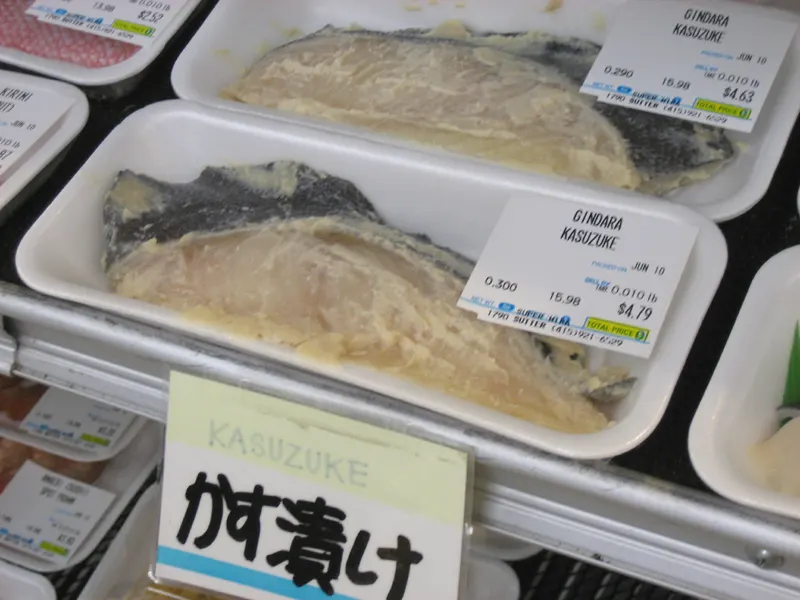
Wooden tablets from Heijo-kyo, the 8th-century capital, record "kasuzuke". The first lees were the dregs of cloudy doburoku sake. Filtered sake from the Muromachi period made lees common, and the Nara doctor Itoya Sosen sold shirouri pickled in sake lees in the Azuchi-Momoyama and Edo periods.