Side-by-side or overlay PDF diff driven by one engine that reads each file into a structured model — text, vector geometry, images, form fields, annotations — and compares the models. Moves show as moves, edits show only where they happened, and any PDF type works without picking a mode.
Open a STEP / STP part and it measures itself — volume, thinnest wall, draft and undercut checks on load, plus hole detection with a BOM. Measure, section, export STL. Rust + WASM B-rep kernel, runs in your browser.
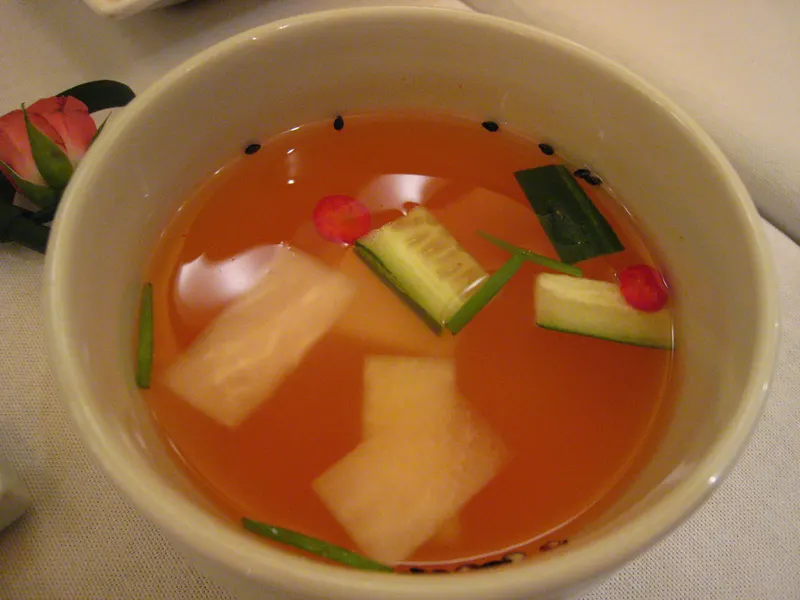
Nabak kimchi is a water kimchi of thin radish and napa cabbage squares, salted for a short time and covered with water in which chilli powder has been steeped and strained out. It ferments quickly and is eaten young, as a cool, sour broth with crisp vegetables.
Amounts from a sourceMean amounts from Korean cookbooks and literature, standardized by the Kimchi Research Institute of Pusan National University in 2005, for every 100 mL of water.
Steeped in the water and squeezed out through two layers of gauze[kong2005]
Total time across the recorded steps: 7 days – 32 days
Start
Drag the bar or press Play
What changes:Radish and cabbage are cut into thin, even squares
Step 1 of 6
Cut radish and cabbage into thin squares
Time
Not documented
Temperature
Not documented
Salt
None given
Acidity
Not documented
Which microbes the steps name, step by step
Leuconostoc
Lactobacillus
L. mesenteroides
Lactobacillus plantarum
Output: thin squares of radish and cabbage.
Flavour
Not documented
Texture
Not documented
Colour
Not documented
Microbes at work in this step
Not documented for this step.
Method
Measured measured in a studySet fixed by a specification or tested recipeReported one source reports itTypical a general value, not sourced for this fermentUnconfirmed not yet checked against a source
At a glance
Nabak kimchi is a water kimchi of thin radish and napa cabbage squares, salted for a short time and covered with water in which chilli powder has been steeped and strained out. It ferments quickly and is eaten young, as a cool, sour broth with crisp vegetables. Made in 6 steps over 7 days – 32 days. The longest step, keep in a kimchi refrigerator, takes 6–24 days (Lim S.-Y 2005) and runs at 4 °C (Lim S.-Y 2005). Salt is 1.3–1.7 % (강근옥 1995). Leuconostoc, high in number and highest late in the ferment at 5 °C and Lactobacillus, low at 5 °C do most of the fermenting.
Nabak kimchi ripens at very little acid. At best ripeness its acidity is about 0.20–0.25 %, far below that of a paste kimchi such as yeolmu kimchi. The chilli is steeped and strained, so the broth has no flakes.
A 1995 survey in Seoul and Chungcheong found nabak kimchi among the kimchi made for winter, beside cabbage kimchi, kkakdugi, chonggak kimchi, dongchimi, bossam kimchi and baek kimchi.
Starter
The sources we found do not say how its fermentation begins.