Side-by-side or overlay PDF diff driven by one engine that reads each file into a structured model — text, vector geometry, images, form fields, annotations — and compares the models. Moves show as moves, edits show only where they happened, and any PDF type works without picking a mode.
Open a STEP / STP part and it measures itself — volume, thinnest wall, draft and undercut checks on load, plus hole detection with a BOM. Measure, section, export STL. Rust + WASM B-rep kernel, runs in your browser.
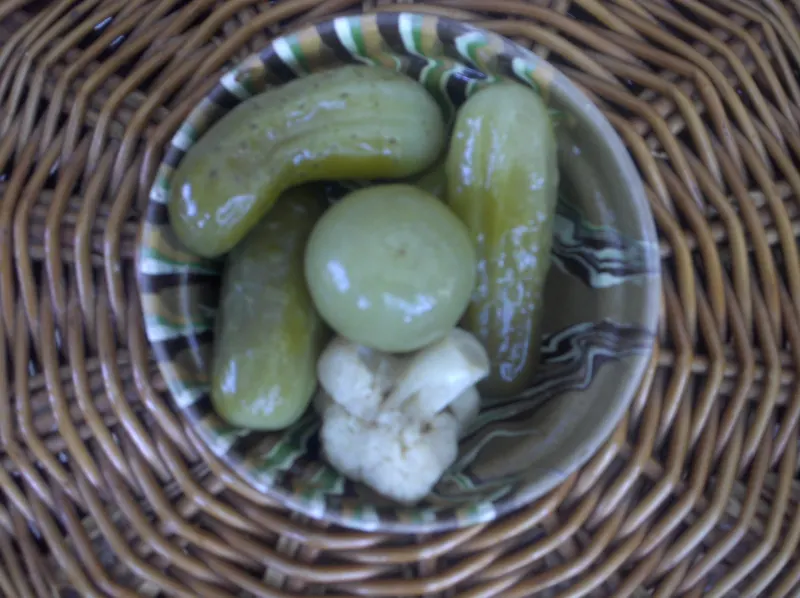
Murături (Romanian brined pickles: varză murată and green tomatoes)murături
Murături are the pickles Romanian households put down in late autumn for the cold months. The main one is varză murată, whole cabbage heads soured in brine in a barrel; green tomatoes are also pickled in jars in a lightly vinegared marinade. In the cabbage, lactic bacteria do the souring.
Amounts from a sourceThe cabbage brine is a traditional household ratio. The marinade amounts are one laboratory batch of green-tomato pickles from Galați, split into three parts of five jars each.
Non-iodised salt, for the cabbage brine1.5 tablespoons per litre of water
Total time across the recorded steps: 35 days – 2.3 months
Start
Drag the bar or press Play
What changes:Whole cabbage heads go under brine in a barrel, weighted with a stone
Step 1 of 4
Put down whole cabbage heads in a barrel
Time
Not documented
Temperature
Not documented
Salt
None given
Acidity
Not documented
Which microbes the steps name, step by step
L. mesenteroides
Lactobacillus plantarum
Lactic acid bacteria
Some households leave the heads outside about 15 days after harvest first. The cored heads are filled with salt and packed core up with dill, thyme, horseradish, corn kernels and quince or apple, then covered with brine.
Flavour
Not documented
Texture
Not documented
Colour
Not documented
Microbes at work in this step
Not documented for this step.
Method
Measured measured in a studySet fixed by a specification or tested recipeReported one source reports itTypical a general value, not sourced for this fermentUnconfirmed not yet checked against a source
At a glance
Murături are the pickles Romanian households put down in late autumn for the cold months. The main one is varză murată, whole cabbage heads soured in brine in a barrel; green tomatoes are also pickled in jars in a lightly vinegared marinade. In the cabbage, lactic bacteria do the souring. Made in 4 steps over 35 days – 2.3 months. The longest step, sour the cabbage, racking the brine, takes 7–42 days (AGERPRES (Business OTS section) 2026) and runs at 18–22 °C (AGERPRES (Business OTS section) 2026). Salt is 0.6 % → 0.74 % (Mocanu G.-D 2022). Leuconostoc mesenteroides in the first 3–5 days of the cabbage ferment, then Lactobacillus plantarum and Lactic acid bacteria at 4.11–4.63 log CFU at day 28 of the green-tomato ferment, across the NaCl, KCl and MgCl2 versions of the pickle do most of the fermenting.
Murături put whole cabbage heads into a barrel of brine, with the brine racked weekly, and also pickle green tomatoes in jars. Some green-tomato recipes add vinegar and sugar to the brine, so they are partly acid pickles rather than purely lactic ones.
In Romania cabbage is traditionally put down between St Demetrius' Day (26 October) and St Andrew's Day (30 November). Green pickled tomatoes are described as a traditional product for the cold months.