Side-by-side or overlay PDF diff driven by one engine that reads each file into a structured model — text, vector geometry, images, form fields, annotations — and compares the models. Moves show as moves, edits show only where they happened, and any PDF type works without picking a mode.
Open a STEP / STP part and it measures itself — volume, thinnest wall, draft and undercut checks on load, plus hole detection with a BOM. Measure, section, export STL. Rust + WASM B-rep kernel, runs in your browser.
Wheat bran and a little maize flour are stirred into water with some sediment from the last batch and left in a loosely closed vessel for two or three days. Lactic bacteria and yeasts turn the liquid sour, and it is strained off to sour ciorbă soups or to drink.
Sometimes added to start the fermentation[zugravu2025]
Starter
backslop (huște sediment from the previous batch); the first starter comes from spontaneous fermentation
Total time across the recorded steps: 2 days – 3 days
Start
Drag the bar or press Play
What changes:Wheat bran, maize flour and old sediment are stirred into water
Step 1 of 4
Mix bran, maize flour, water and starter
Time
Not documented
Temperature
Not documented
Salt
None given
Acidity
Not documented
Which microbes the steps name, step by step
Lactic acid bacteria
Yeasts
Output: bran suspension.
Flavour
Not documented
Texture
Not documented
Colour
Not documented
Microbes at work in this step
Not documented for this step.
Method
Measured measured in a studySet fixed by a specification or tested recipeReported one source reports itTypical a general value, not sourced for this fermentUnconfirmed not yet checked against a source
At a glance
Wheat bran and a little maize flour are stirred into water with some sediment from the last batch and left in a loosely closed vessel for two or three days. Lactic bacteria and yeasts turn the liquid sour, and it is strained off to sour ciorbă soups or to drink. Made in 4 steps over 2 days – 3 days. The longest step, leave to sour in a loosely closed vessel, takes 2–3 days (Pasqualone A 2018) and runs at 14–15 °C (Pasqualone A 2018). Lactic acid bacteria, mostly lactobacilli; Lactobacillus amylolyticus the most common and abundant species and Yeasts Pichia kudriavzevii and Kluyveromyces marxianus do most of the fermenting.
Borș is a sour liquid, not a porridge or a beer. Wheat bran is the main substrate, and the sediment of each batch starts the next one. It is a different thing from beetroot borscht.
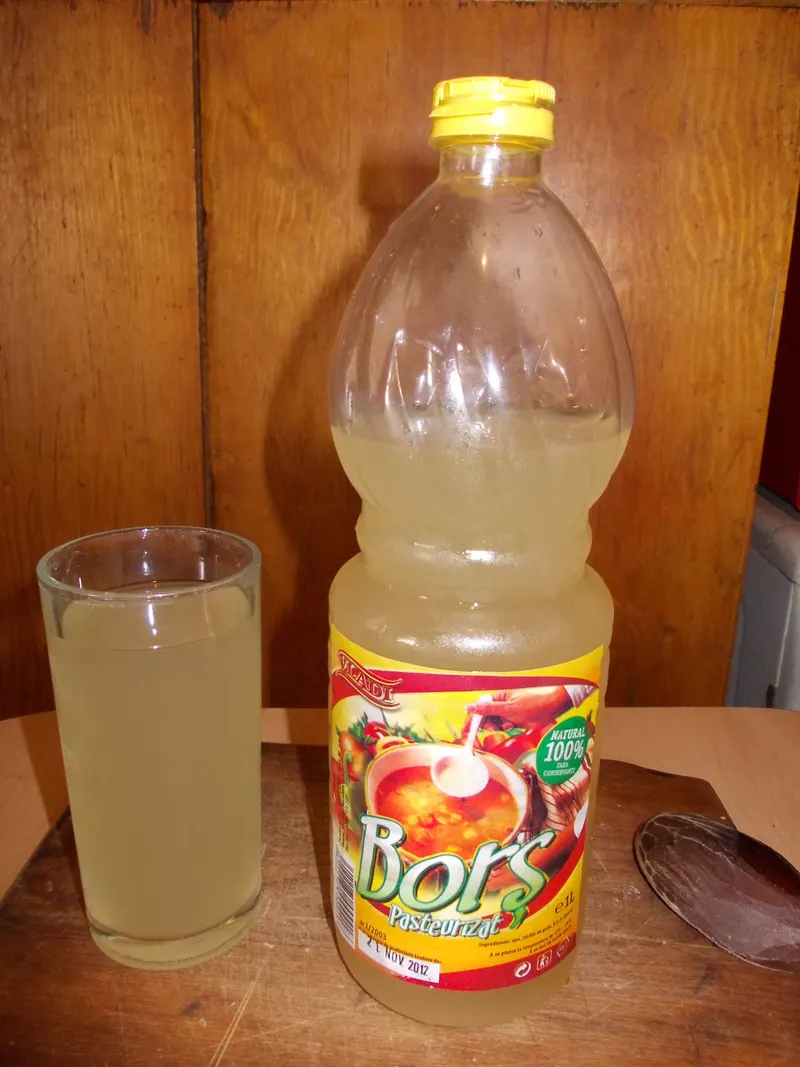
Commercial borșUsually pasteurised; two retail samples measured pH 3.3 and 3.4.
Cibere (Hungary)The historical Hungarian name for a similar bran sour.
Safety
In a 2026 preprint, all 101 bacterial strains isolated from borș inhibited at least one indicator bacterium, and all inhibited Listeria monocytogenes in laboratory tests. Finished borș is acid, with pH 3.3 to 4.2 in a 2018 study, and all samples were below pH 4.0 in a 2019 study. The traditional description has it filtered, bottled and stored at 4 °C; artisanal producers sell it unpasteurised and industrial borș is usually pasteurised.
Pasqualone and colleagues write that borș has been used as a flavouring in Romanian cooking since ancient times, and Wikipedia says it used to be common in Hungary too, as cibere. Their 2018 paper says no earlier study had defined its physico-chemical characteristics. A 2019 paper investigated Romanian borș microbiologically for the first time, and a 2026 preprint sequenced the microbiota of 32 commercial and homemade samples.