Side-by-side or overlay PDF diff driven by one engine that reads each file into a structured model — text, vector geometry, images, form fields, annotations — and compares the models. Moves show as moves, edits show only where they happened, and any PDF type works without picking a mode.
Open a STEP / STP part and it measures itself — volume, thinnest wall, draft and undercut checks on load, plus hole detection with a BOM. Measure, section, export STL. Rust + WASM B-rep kernel, runs in your browser.
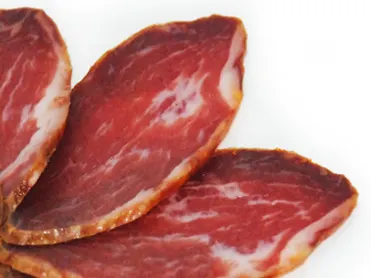
Lomo embuchado is a whole pork loin that is salted, seasoned with an adobo marinade, stuffed into a casing and cured. It is mainly a dry-cured meat rather than an acid ferment, though surface yeasts such as Debaryomyces hansenii grow on it. Spanish law caps its moisture at 55 % and sets at least 70 days of curing for ibérico loin.
Amounts from a sourceShares of the loin weight from a university study that salted and seasoned loins "in accordance with the common technique of Spanish producers" but used Korean spices (Choe et al. 2014).
Whole pork loin
One piece, practically free of external fat, aponeuroses and tendons[rd474-2014]
The study used 4 % Korean red pepper paste, 1 % onion, 1 % garlic and 1 % ginger powder, a Korean adaptation[choe2014]
Nitrite0.02 % of loin weight
One study's figure. It does not say whether this is pure sodium nitrite or a curing-salt mix, so it is not a home dose[choe2014]
Casing
Natural casing or artificial wrapping; cattle large intestine in the study[rd474-2014][choe2014]
Starter
spontaneous
Total time across the recorded steps: 52 days – 3.2 months
Start
Drag the bar or press Play
What changes:The whole pork loin is trimmed of fat and fascia
Step 1 of 4
Trim the loin
Time
Not documented
Temperature
Not documented
Salt
None given
Acidity
Not documented
Which microbes the steps name, step by step
Yeasts
Flavour
Not documented
Texture
Not documented
Colour
Not documented
Microbes at work in this step
Not documented for this step.
Method
Measured measured in a studySet fixed by a specification or tested recipeReported one source reports itTypical a general value, not sourced for this fermentUnconfirmed not yet checked against a source
At a glance
Lomo embuchado is a whole pork loin that is salted, seasoned with an adobo marinade, stuffed into a casing and cured. It is mainly a dry-cured meat rather than an acid ferment, though surface yeasts such as Debaryomyces hansenii grow on it. Spanish law caps its moisture at 55 % and sets at least 70 days of curing for ibérico loin. Made in 4 steps over 52 days – 3.2 months. The longest step, cure and mature, takes 45 days – 3 months (Choe H.S 2014) and runs at 12 °C (Choe H.S 2014). Salt is 2 % (Choe H.S 2014). Debaryomyces hansenii, a yeast isolated from naturally fermented lomo embuchado; an inoculated strain grew on the surface of Iberian loin does most of the fermenting.
Lomo embuchado is a single whole muscle, salted only briefly and then cured, not a minced and fermented sausage like chorizo. Unlike ham, it gets only a short salting before drying.
Caña de lomo ibéricoFrom ibérico pigs; at least 70 days of processing under Spanish law.
Safety
Spanish quality standards cap the moisture of lomo embuchado at 55 % and require at least 70 days of processing for ibérico loin; it is eaten without cooking. This is raw pork, and CDC says curing, drying or smoking alone does not consistently kill Trichinella worms. CDC also says freezing pork less than 15 cm thick for 20 days at -15 °C kills them. Pure sodium nitrite is a white crystal that can be mistaken for salt, and swallowing it can cause methemoglobinemia, which starves the body of oxygen. Keep it labelled and do not treat the study's 0.02 % as a tested home recipe.