Side-by-side or overlay PDF diff driven by one engine that reads each file into a structured model — text, vector geometry, images, form fields, annotations — and compares the models. Moves show as moves, edits show only where they happened, and any PDF type works without picking a mode.
Open a STEP / STP part and it measures itself — volume, thinnest wall, draft and undercut checks on load, plus hole detection with a BOM. Measure, section, export STL. Rust + WASM B-rep kernel, runs in your browser.
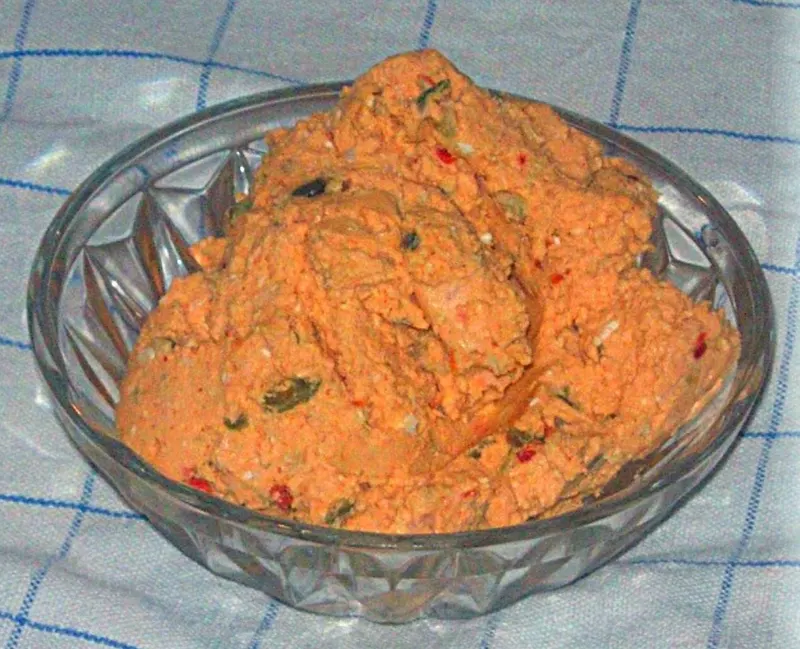
Liptauer is a spread, not a cheese of its own. Ripened sheep bryndza, or fresh curd cheese (Topfen, quark) in its place, is pushed through a sieve and beaten with butter, then seasoned with sweet paprika, caraway, pepper and grated onion. The fermentation happens in the bryndza, which ripens for 10 to 13 days before it is milled with salt.
Photo: Unknown author, Public domain, via Wikimedia Commons
No fixed amounts recordedNo fixed amounts. The Austrian food code requires that at least 51% of the dry matter of a fresh-cheese preparation such as Liptauer comes from cheese, counting the added milk fat, and bans edible oils and fats or proteins not from milk.
The bryndza ripens on the lactic acid bacteria of raw ewe milk. The paper says a starter culture must be added after the milk is pasteurised.
Total time across the recorded steps: 11 days – 14 days
Start
Drag the bar or press Play
What changes:The renneted ewe-milk curd is formed into a lump that drains for 24 hours
Step 1 of 4
Drain the ewe-milk lump cheese
Time
24 h
Reported
Temperature
18–22 °C
Reported
Salt
None given
Acidity
Not documented
Which microbes the steps name, step by step
Lactic acid bacteria
Yeasts
Output: drained lump cheese, renneted at 29–31 °C for 30 min.
Flavour
Not documented
Texture
Not documented
Colour
Not documented
Microbes at work in this step
native non-starter lactic acid bacteria of the raw ewe milk are present in the lump
Method
Measured measured in a studySet fixed by a specification or tested recipeReported one source reports itTypical a general value, not sourced for this fermentUnconfirmed not yet checked against a source
At a glance
Liptauer is a spread, not a cheese of its own. Ripened sheep bryndza, or fresh curd cheese (Topfen, quark) in its place, is pushed through a sieve and beaten with butter, then seasoned with sweet paprika, caraway, pepper and grated onion. The fermentation happens in the bryndza, which ripens for 10 to 13 days before it is milled with salt. Made in 4 steps over 11 days – 14 days. The longest step, ripen the lump into bryndza, takes 10–13 days (Štefániková J 2020) and runs at 12–22 °C (Štefániková J 2020). Salt is 4–6 % (Štefániková J 2020). Lactic acid bacteria of the bryndza and Yeasts of the bryndza, mostly Dipodascus geotrichum do most of the fermenting.
Liptauer is a prepared spread, not a separately fermented cheese. Made with bryndza, it carries a sheep cheese that ripened for 10 to 13 days before it was milled with salt. The Austrian food code defines it with fresh Topfen instead, which is a fresh cheese.
Milk
Sheep-milk bryndza, or cow-milk Topfen or quark
Austrian food code
Listed among fresh-cheese preparations made from Topfen with butter or cream and flavouring ingredients; at least 51% of the dry matter from cheese
Bryndzová nátierka / šmirkás (Slovakia)Made with Slovak bryndza.
Austrian LiptauerUsually Topfen with butter or cream.
Safety
Raw-milk bryndza carried coliform bacteria at 3.46–6.78 log CFU/g in a Slovak study of eight producers, which the authors take as a sign of poor hygiene in milk processing, except at two farms; the one pasteurised-milk sample had under 1 log CFU/g. Liptauer made with Topfen or quark instead of bryndza is not covered by that study.
Hazards the sources name: Coliform bacteria, found at 3.46–6.78 log CFU/g in bryndza made from unpasteurised ewe milk (below 1 log CFU/g in one pasteurised sample); the authors read them as a sign of poor hygiene.
The word bryndza is first written in Slovakia in a charter of 17 September 1470, which required settlers at Valaská to pay the Ľupča castle 25 rams, 25 wethers and bryndza each year. The first dedicated bryndza dairy opened in Detva in 1787. In 1892 a Zvolen maker, Teodor Vallo, began adding a salt solution instead of dry salt and got the soft, spreadable bryndza still made today. By 1905 the Detva dairy of the Vagač family sent most of its yearly 1,200 to 1,300 metric centners of bryndza to Vienna. These dates are for bryndza, the base of the spread.