Side-by-side or overlay PDF diff driven by one engine that reads each file into a structured model — text, vector geometry, images, form fields, annotations — and compares the models. Moves show as moves, edits show only where they happened, and any PDF type works without picking a mode.
Open a STEP / STP part and it measures itself — volume, thinnest wall, draft and undercut checks on load, plus hole detection with a BOM. Measure, section, export STL. Rust + WASM B-rep kernel, runs in your browser.
Cheese from Netherlands, polder districts around Leiden in the Oude Rijn basin
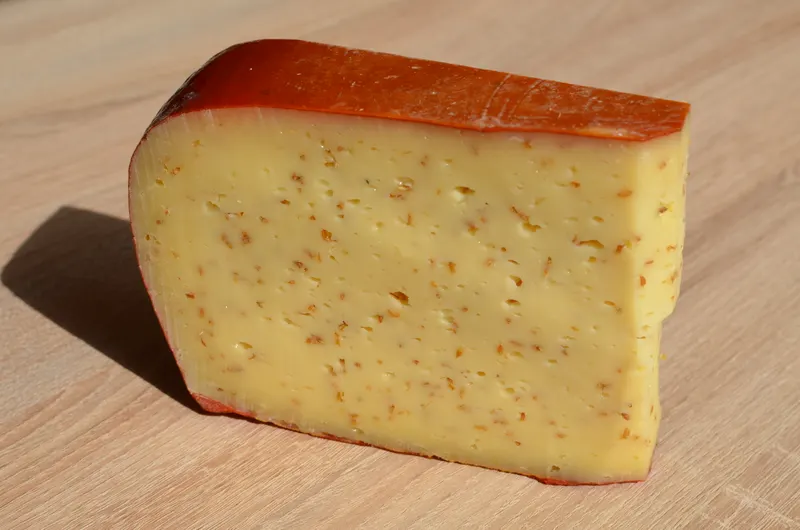
Leidse Kaas PDO (Boeren-Leidse met sleutels)Boeren-Leidse met sleutels
Semi-skimmed raw cow milk from no more than two milkings is set with rennet at 29–30 °C, cut, and warmed with hot water. Most of the curd is mixed with cumin seed, about 75 g per 100 L of milk, while a little plain curd lines the faces, and the cheese is pressed in two stages and stamped with Leiden's crossed keys. It is brined 5–6 days in 20 °Bé brine, its rind is coloured red with annatto, and it ripens at 12 °C or more.
Amounts from a sourceThe PDO gives one dose, cumin at about 75 g of seed per 100 L of milk; everything else is a limit, not a recipe.
Raw cow milk, semi-skimmed, from no more than two successive milkings
Milk not used at once is cooled to 10 °C or less; under the TSG it may not be heated above 40 °C and must be made into cheese within 40 hours[leidse-pdo][boerenkaas-tsg]
Mixed culture of acid-forming bacteria (lactic, propionic and aroma-forming cultures are allowed)
a mixed culture of acid-forming bacteria (TSG Boerenkaas)
Total time across the recorded steps: 18 days – 19 days
Start
Drag the bar or press Play
What changes:Raw milk from two milkings is chilled and part of its cream is taken off
Step 1 of 7
Cool and collect the farm milk
Time
Not documented
Temperature
up to 10 °C
Set
Salt
None given
Acidity
Not documented
Which microbes the steps name, step by step
Lactic acid bacteria
Milk from not more than two successive milkings, part-skimmed. Under the TSG it must be made into cheese within 40 hours of milking.
Flavour
Not documented
Texture
Not documented
Colour
Not documented
Microbes at work in this step
Not documented for this step.
Method
Measured measured in a studySet fixed by a specification or tested recipeReported one source reports itTypical a general value, not sourced for this fermentUnconfirmed not yet checked against a source
At a glance
Semi-skimmed raw cow milk from no more than two milkings is set with rennet at 29–30 °C, cut, and warmed with hot water. Most of the curd is mixed with cumin seed, about 75 g per 100 L of milk, while a little plain curd lines the faces, and the cheese is pressed in two stages and stamped with Leiden's crossed keys. It is brined 5–6 days in 20 °Bé brine, its rind is coloured red with annatto, and it ripens at 12 °C or more. Made in 7 steps over 18 days – 19 days. The longest step, colour the rind red and ripen, takes at least 13 days (Hoofdproduktschap voor Akkerbouwprodukten 1994) and runs at at least 12 °C (Hoofdproduktschap voor Akkerbouwprodukten 1994). Salt is 18–22 % (RVO (Netherlands Enterprise Agency)). A mixed culture of acid-forming lactic bacteria; propionic and aroma-forming cultures are also allowed does most of the fermenting.
Unlike Gouda boerenkaas, which is full-fat (at least 48 % fat in dry matter), Leidse is made from part-skimmed milk, so it is lower in fat (30+ or 35+). It carries cumin, mixed into the curd but kept off the faces by a layer of plain curd. Its red annatto rind and key stamp mark it out.
Fat
Fat in dry matter 30–40 % in the PDO; the TSG table gives 30+ or 35+ for Leidse
Moisture
At most 45 % at 12 days (TSG Leidse Boerenkaas)
Shape
Flat cylinder with angular edges (the 'Leids model')
The cheese is made from raw milk. Under the TSG the milk may not be heated above 40 °C, must be cheesed within 40 hours, and the cheese ripens at least 13 days at 12 °C or more, with a pH of 5.20–5.30 at 12 days. The US FDA says ageing raw-milk cheese for 60 days may not remove E. coli O157:H7 and Salmonella. The CDC says people at higher risk, including pregnant women, people 65 or older and people with weak immunity, should avoid raw-milk cheese unless it is heated to 165 °F (74 °C) or until steaming hot.
The PDO file quotes a German cheese handbook that Leiden cheese was marked with the city's crossed keys and may be the origin of Norway's nøkkelost. It was traded in Leiden from the 17th and 18th centuries and, being part-skimmed, kept well as ships' provisions. The cheesemakers' association was founded on 28 October 1927, and the name was registered as a PDO in 1997.