Side-by-side or overlay PDF diff driven by one engine that reads each file into a structured model — text, vector geometry, images, form fields, annotations — and compares the models. Moves show as moves, edits show only where they happened, and any PDF type works without picking a mode.
Open a STEP / STP part and it measures itself — volume, thinnest wall, draft and undercut checks on load, plus hole detection with a BOM. Measure, section, export STL. Rust + WASM B-rep kernel, runs in your browser.
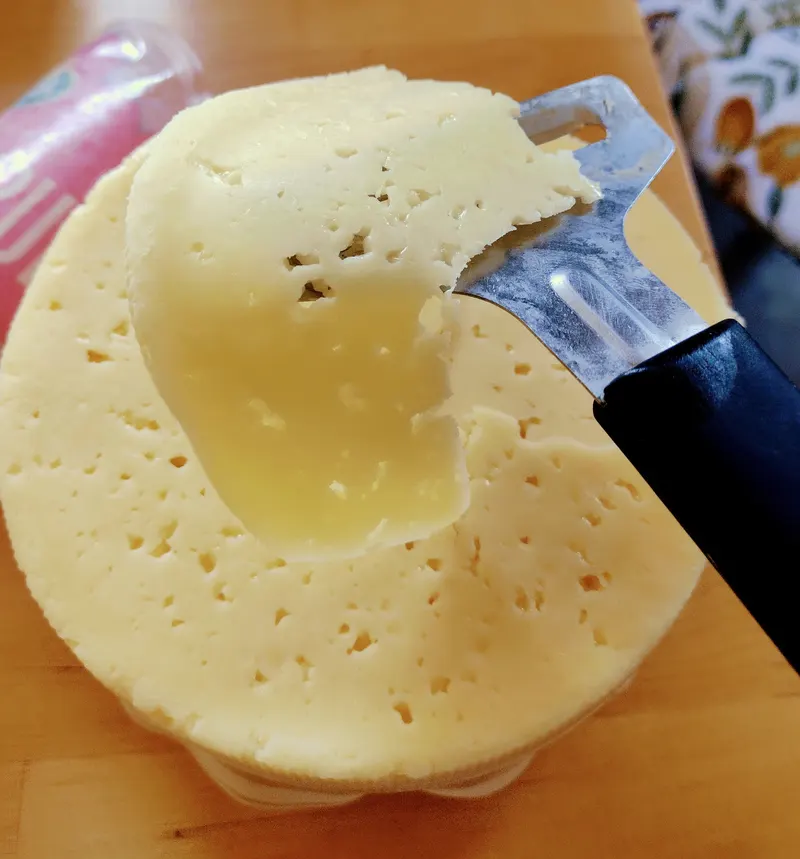
Hushållsost is a small Swedish 'household' cylinder of semi-hard cow cheese. Pasteurised milk is set with rennet at 30–32 °C, and the curd is heated to 35–40 °C, then moulded, salted and coated in paraffin. It is normally ready after about two months and has small irregular eyes and a mild, slightly lactic taste.
Measured measured in a studySet fixed by a specification or tested recipeReported one source reports itTypical a general value, not sourced for this fermentUnconfirmed not yet checked against a source
At a glance
Hushållsost is a small Swedish 'household' cylinder of semi-hard cow cheese. Pasteurised milk is set with rennet at 30–32 °C, and the curd is heated to 35–40 °C, then moulded, salted and coated in paraffin. It is normally ready after about two months and has small irregular eyes and a mild, slightly lactic taste. Made in 6 steps over 2 months. The longest step, ripen, takes 2 months (El Salvador 1969).
A small cylinder cheese with irregular eyes from pin-head to rice-grain size, set at 30–32 °C and ready after about two months. Its name lost protection in 2023 because it was an unreserved TSG.
Rind
Hard, tough, dry (paraffin); straw-yellow to yellow
Size
Cylinder 10–17 cm across and 5–15 cm high, usually 1–2 kg
Fat classes
At least 45, 50 or 55% fat in dry matter, with at most 46, 44 or 41% moisture
The Codex Alimentarius set a standard for Hushållsost in 1969 (C-22). The EU registered it as an unreserved TSG on 10 February 2004; under the 2012 rules that protection ran only until 4 January 2023. The Swedish Food Agency likewise records that Hushållsost was once registered as a TSG and that the protection ended on 4 January 2023.