Side-by-side or overlay PDF diff driven by one engine that reads each file into a structured model — text, vector geometry, images, form fields, annotations — and compares the models. Moves show as moves, edits show only where they happened, and any PDF type works without picking a mode.
Open a STEP / STP part and it measures itself — volume, thinnest wall, draft and undercut checks on load, plus hole detection with a BOM. Measure, section, export STL. Rust + WASM B-rep kernel, runs in your browser.
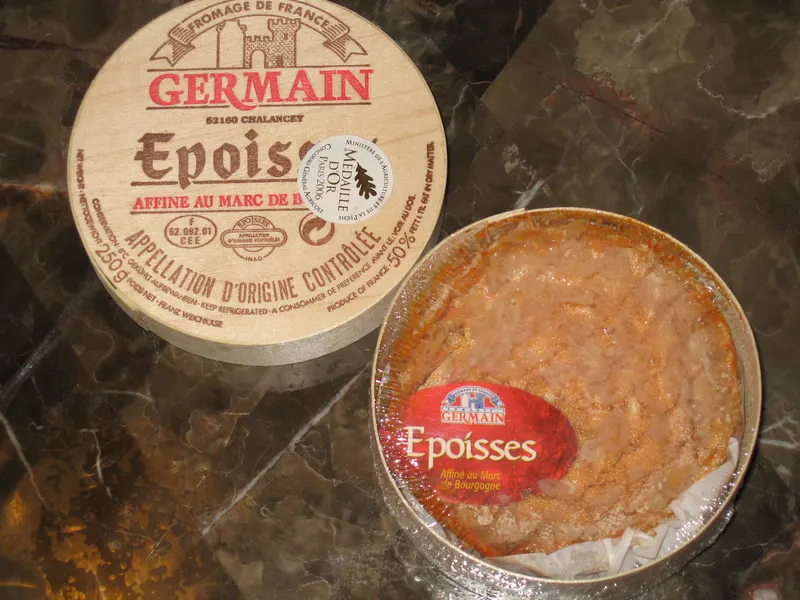
Whole cow milk sets slowly, mostly by lactic souring with a little rennet, for more than 16 hours. The curd is cut coarsely, drained in moulds without pressing and dry-salted. For at least four weeks the cheese is washed one to three times a week, first with water and then with stronger and stronger Marc de Bourgogne, until the rind is orange to brick red.
What changes:Lactic bacteria sour whole milk slowly, and it sets into a fragile curd overnight
Step 1 of 5
Set the milk slowly by lactic souring
Time
at least 16 h
Set
Temperature
Not documented
Salt
None given
Acidity
Not documented
Which microbes the steps name, step by step
Lactic acid bacteria
Yeasts
Geotrichum candidum
Output: lactic curd.
Flavour
Not documented
Texture
fragile, acid curd
Colour
white
Microbes at work in this step
lactic bacteria sour the milk; a little rennet helps it set
Method
Measured measured in a studySet fixed by a specification or tested recipeReported one source reports itTypical a general value, not sourced for this fermentUnconfirmed not yet checked against a source
At a glance
Whole cow milk sets slowly, mostly by lactic souring with a little rennet, for more than 16 hours. The curd is cut coarsely, drained in moulds without pressing and dry-salted. For at least four weeks the cheese is washed one to three times a week, first with water and then with stronger and stronger Marc de Bourgogne, until the rind is orange to brick red. Made in 5 steps over 29 days. The longest step, wash with water, then with Marc de Bourgogne, takes at least 28 days (INAO 2006). Lactic acid bacteria that set the curd and Debaryomyces hansenii and Geotrichum candidum do most of the fermenting.
Époisses is set mainly by slow lactic souring, not by rennet, so its curd is fragile and is drained without pressing. Its rind is washed with Marc de Bourgogne in rising strength. Most washed-rind cheeses, such as Maroilles, are rennet-set and washed with brine alone.
Milk
Whole milk only from Brune, Montbéliarde or French Simmental cows, made into cheese the day it is collected
Setting
Lactic-dominant set of more than 16 h; pH below 4.5 at unmoulding; drained without pressing and dry-salted
Washing
Washed 1–3 times a week with water, then water with more and more Marc de Bourgogne, for at least 4 weeks
Ripening
At least 4 weeks
Size
250–350 g (95–115 mm across) or 700–1100 g (165–190 mm); fat in dry matter at least 50%
The specification requires a mostly lactic set (more than 16 h) and a cheese pH below 4.5 at unmoulding. Milk is made into cheese the day it is collected, or within 24 h where collection is daily or the cheese is made on the farm. Feeds that risk bacterial contamination are banned from the herd's ration, and keeping milk or curd frozen or holding cheeses in a modified atmosphere is forbidden. The sources do not say whether the milk is raw; Wikipedia says it may be raw or pasteurised. For raw-milk cheeses, ANSES names Listeria, Salmonella and enterohaemorrhagic E. coli as the main hazards. It advises pregnant women, people over 65, people with weak immunity and young children not to eat them, except cooked pressed ones such as Comté, which this soft cheese is not.
Legend credits Cistercian monks at Époisses in the early 16th century; farm women then improved the making. Brillat-Savarin called it the king of cheeses in 1825. By 1940 an estimated 500 cheeses a week were shipped to Autun, Avallon, Dijon, Paris and Semur. Production declined after the First World War and had almost stopped by the 1950s; Robert and Simone Berthaut relaunched it in 1956. It became an appellation by decree on 14 May 1991.
Starter
The sources we found do not say how its fermentation begins.