Side-by-side or overlay PDF diff driven by one engine that reads each file into a structured model — text, vector geometry, images, form fields, annotations — and compares the models. Moves show as moves, edits show only where they happened, and any PDF type works without picking a mode.
Open a STEP / STP part and it measures itself — volume, thinnest wall, draft and undercut checks on load, plus hole detection with a BOM. Measure, section, export STL. Rust + WASM B-rep kernel, runs in your browser.
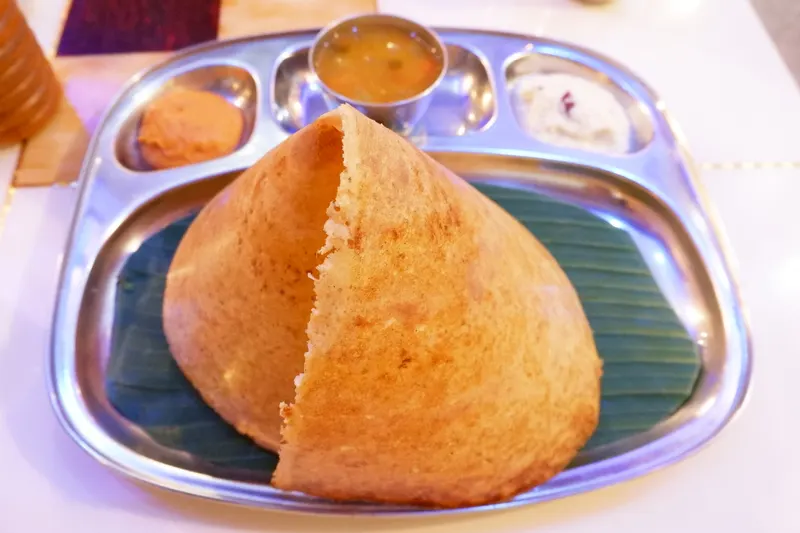
Rice and dehulled black gram are soaked, ground fine and fermented overnight into a sour batter. The batter is thinned, spread in a thin circle on a hot griddle with a little oil and cooked into a crisp pancake.
Amounts from a sourceNo tested recipe with weights was found. One study made its batter from rice and black gram 3:1, soaked overnight, ground fine and left to ferment overnight; it does not say whether the parts are by weight.
Rice3 parts
Proportion used in one study; the source does not say whether by weight or volume[kumari2022]
For soaking, for grinding, and to thin the batter before cooking
No starter
The bacteria come in on the grains, as in idli[fao138]
Starter
spontaneous
Start
Drag the bar or press Play
What changes:Water soaks into the rice and black gram and softens them
Step 1 of 4
Soak rice and black gram
Time
Not documented
Temperature
Not documented
Salt
None given
Acidity
Not documented
Which microbes the steps name, step by step
L. mesenteroides
Enterococcus faecalis
Soaked as for idli; one study soaked the grains overnight. Output: soft, swollen grains.
Flavour
Not documented
Texture
Not documented
Colour
Not documented
Microbes at work in this step
Not documented for this step.
Method
Measured measured in a studySet fixed by a specification or tested recipeReported one source reports itTypical a general value, not sourced for this fermentUnconfirmed not yet checked against a source
At a glance
Rice and dehulled black gram are soaked, ground fine and fermented overnight into a sour batter. The batter is thinned, spread in a thin circle on a hot griddle with a little oil and cooked into a crisp pancake. Leuconostoc mesenteroides and Enterococcus faecalis do most of the fermenting.
Dosa batter is very similar to idli batter, except that the rice and black gram are both ground fine, and the fermented batter is quickly fried as a thin, fairly crisp pancake instead of being steamed.
Set dosa and benne dose (Davanagere)Set dosa is smaller, spongy, soft and light, served in sets of 2–3. Benne dose is made with butter and is best known as Davanagere benne dose.
UttapamMuch thicker and softer than dosa, served with vegetable toppings.
Ragi dosaMade of ragi (finger millet) flour mixed with small portions of rice and urad dal. A 2012 study fermented finger millet with horse gram flour instead, and made its dosa from the 16-h fermented batter.
Neer dosa, adai, pesarattu and rava dosaNeer dosa is made from a watery rice batter, adai from toor dal, rice and spices in a batter that is not fermented, pesarattu from green gram and rava dosa from semolina.
Safety
A warm overnight ferment can fall in the 28–35 °C range where Bacillus cereus grows best (FDA). Two FDA tables put its lowest growth pH at 4.9 and at 4.3, so souring slows it but does not rule it out. Cooking may kill the bacteria, but their spores are tough and the vomiting toxin survives 121 °C for 30 minutes, so do not hold batter warm for long, and refrigerate leftover batter at 4 °C (40 °F) or lower. Do not taste raw batter, since raw grain and flour can carry Salmonella and E. coli (FDA).
The food historian K.T. Achaya dates the first written mention to 8th-century Tamil literature, with Kannada texts about a century later. The 12th-century Sanskrit Manasollasa gives a recipe.
Process times
The sources we found give no figure for how long any of its steps take.
Temperature, salt and pH
The sources we found give no temperature, salt or pH figure for any of its steps.
[gupta2014] Gupta A., Tiwari S.K. 2014, Probiotic potential of Lactobacillus plantarum LD1 isolated from batter of dosa, a South Indian fermented food, Probiotics and Antimicrobial Proteins 6:73–81, doi:10.1007/s12602-014-9158-2paper