Side-by-side or overlay PDF diff driven by one engine that reads each file into a structured model — text, vector geometry, images, form fields, annotations — and compares the models. Moves show as moves, edits show only where they happened, and any PDF type works without picking a mode.
Open a STEP / STP part and it measures itself — volume, thinnest wall, draft and undercut checks on load, plus hole detection with a BOM. Measure, section, export STL. Rust + WASM B-rep kernel, runs in your browser.
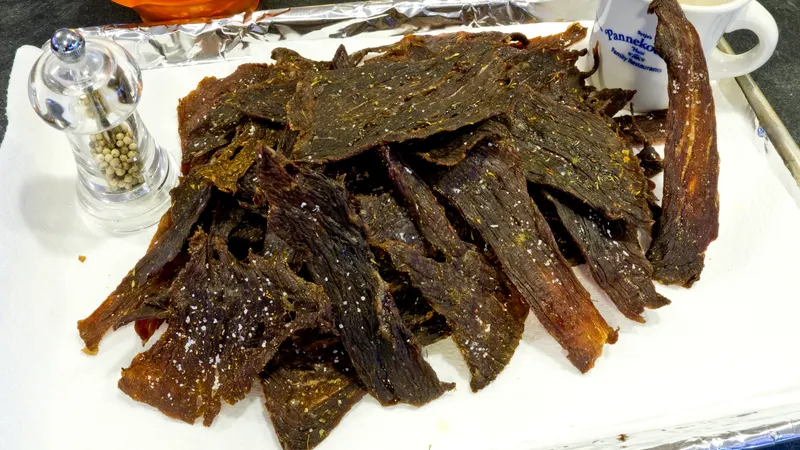
Ch'arki is the Andean salted, sun-dried meat whose Quechua name gave English "jerky". Meat of llama, alpaca, sheep or beef is salted, pressed or piled to drain and dried in the sun to a water activity of about 0.7–0.8 or lower. A 2022 review gives it a shelf life of months at room temperature. Halotolerant bacteria may grow in it.
No fixed amounts recordedTraditional ch'arki has no fixed recipe in the sources read. The one salt figure is a 20 % NaCl (w/v) brine in a study of beef charqui at a Brazilian plant.
Coarse sea salt; modern production first injects the deboned muscle with brine[jimenez2022]
Starter
Autochthonous (naturally present) microorganisms carry out the fermentation (Jimenez et al. 2022).
Total time across the recorded steps: 8.4 days
Start
Drag the bar or press Play
What changes:Meat is cut into thin slices or bone-in pieces
Step 1 of 4
Cut the meat
Time
Not documented
Temperature
Not documented
Salt
None given
Acidity
Not documented
Andean makers use either thin lean slices or whole bone-in carcass flaps.
Flavour
Not documented
Texture
Not documented
Colour
Not documented
Microbes at work in this step
Not documented for this step.
Method
Measured measured in a studySet fixed by a specification or tested recipeReported one source reports itTypical a general value, not sourced for this fermentUnconfirmed not yet checked against a source
At a glance
Ch'arki is the Andean salted, sun-dried meat whose Quechua name gave English "jerky". Meat of llama, alpaca, sheep or beef is salted, pressed or piled to drain and dried in the sun to a water activity of about 0.7–0.8 or lower. A 2022 review gives it a shelf life of months at room temperature. Halotolerant bacteria may grow in it. Made in 4 steps over 8.4 days. The longest step, salt, pile and press, takes 5 days (Youssef E.Y 2007). Salt is 20 % (Youssef E.Y 2007). Autochthonous bacteria, mainly Micrococcus spp., Pediococcus halophilus, Staphylococcus xylosus, lactobacilli and Streptococcus spp. does most of the fermenting.
Ch'arki is preserved by salt and drying and is soaked before use. Jerked beef and carne-de-sol are named as its derivatives; modern production injects brine and dries the meat in the sun on rails.
Charqui from lean slices and bone-in charquiThe two main Andean methods; their chemistry differs.
Jerked beef and carne-de-sol (Brazil)Named by Jimenez et al. as derivatives of charqui, together with charqui itself.
Safety
A water activity of about 0.7–0.8 makes growth of pathogens unlikely, but that is not the same as killing them, and halophilic bacteria from the salt can still spoil the surface. Llama and alpaca meat can carry large Sarcocystis cysts. In trials on infected meat, boiling, baking and frying neutralised the cysts, while curing killed them but toxicity in rabbits varied. Whether these cysts infect people is not established, but a toxin in them has been suggested to make people ill when infected meat is eaten uncooked, so cook charqui through rather than eat it raw.
Hazards the sources name: Halobacterium cutirubrum from the salt, which causes slime, off-odours and red spots.
Wikipedia says the Inca Empire supplied tampu (inns) along its road system with llama ch'arki for travelers. After the Spanish arrived, beef charqui became more common, and it was industrialized in charqueadas in Brazil and saladeros in Argentina and Uruguay.