Side-by-side or overlay PDF diff driven by one engine that reads each file into a structured model — text, vector geometry, images, form fields, annotations — and compares the models. Moves show as moves, edits show only where they happened, and any PDF type works without picking a mode.
Open a STEP / STP part and it measures itself — volume, thinnest wall, draft and undercut checks on load, plus hole detection with a BOM. Measure, section, export STL. Rust + WASM B-rep kernel, runs in your browser.
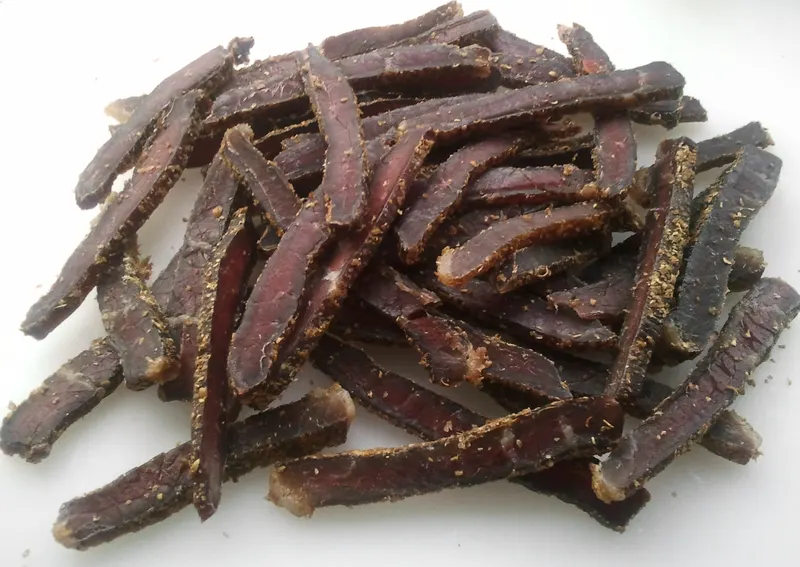
Strips of lean beef are marinated in vinegar, salt, black pepper and coriander and then hung to dry at about 22–25 °C and 55 % relative humidity for 8 days in the trials behind this page. Vinegar, salt and drying are the only controls, because there is no heat step.
What changes:Lean beef is trimmed of fat and cut into thick strips
Step 1 of 4
Trim and cut the beef
Time
Not documented
Temperature
Not documented
Salt
None given
Acidity
Not documented
Output: lean beef pieces cut along the grain.
Flavour
Not documented
Texture
Not documented
Colour
Not documented
Microbes at work in this step
Not documented for this step.
Method
Measured measured in a studySet fixed by a specification or tested recipeReported one source reports itTypical a general value, not sourced for this fermentUnconfirmed not yet checked against a source
At a glance
Strips of lean beef are marinated in vinegar, salt, black pepper and coriander and then hung to dry at about 22–25 °C and 55 % relative humidity for 8 days in the trials behind this page. Vinegar, salt and drying are the only controls, because there is no heat step. Made in 4 steps over 8 days. The longest step, hang to dry, takes 8 days (Karolenko C 2023) and runs at 22.2–25 °C (Karolenko C.E 2020). Salt is 1.7–2.7 % (Karolenko C 2023).
Biltong has no heat step, so vinegar, salt and drying must do all the work. In US trials on beef inoculated with a Salmonella mix and dried in a controlled chamber, same-day marinades with 3–4 % vinegar cut Salmonella by more than 5 log within 7–8 days, but 2 % vinegar did not reach 5 log in 8 days. The authors name how they counted Salmonella as one of the main reasons for the 5-log result; an earlier biltong study that counted per gram never reached 5 log. Water activity was generally below 0.85 after 6–8 days, yet in one measurement the inside of a piece read 0.89–0.90 when the surface read 0.80–0.81. These trials tested Salmonella only and cover that process, not a home batch with another recipe, less vinegar or a different drying box. US makers must validate their process with USDA-FSIS, either as a 5-log Salmonella reduction or a 2-log reduction plus Salmonella testing of every ingredient lot.
Hazards the sources name: Salmonella (the target of process validation; in trials on inoculated beef, same-day marinades with 3–4 % vinegar plus drying cut it more than 5 log, and 2 % vinegar did not); Coagulase-positive staphylococci (in 4 of 14 Czech retail biltong samples, up to 3.4 log CFU/g; the study detected no staphylococcal enterotoxin genes).
Local lore says Afrikaner pioneers first made biltong in the 17th century. Wikipedia calls that story unlikely and says others think early settlers adopted an indigenous custom of preserving meat. It credits the Afrikaners with introducing pepper, coriander and cloves to biltong, and says commandos relied on biltong in the Second Boer War.