Side-by-side or overlay PDF diff driven by one engine that reads each file into a structured model — text, vector geometry, images, form fields, annotations — and compares the models. Moves show as moves, edits show only where they happened, and any PDF type works without picking a mode.
Open a STEP / STP part and it measures itself — volume, thinnest wall, draft and undercut checks on load, plus hole detection with a BOM. Measure, section, export STL. Rust + WASM B-rep kernel, runs in your browser.
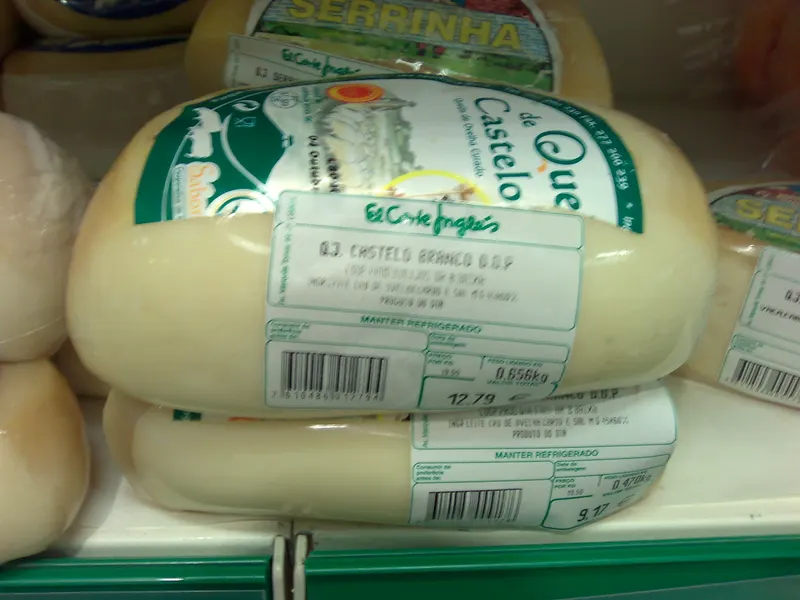
Queijo de Castelo Branco (Queijo da Beira Baixa PDO)Queijo de Castelo Branco
Raw milk from Merino and other local ewes is set with a cardoon (thistle) preparation at 28–36 °C in 40–90 minutes. The curd is cut to the size of rice grains, packed into moulds and pressed until the whey is gone, then salted and cured for at least 40 days. Cured over 90 days it becomes "Velho" (old).
Photo: Adriao, Public domain, via Wikimedia Commons
No fixed amounts recordedThe specification sets temperatures and times but no amounts; salt is "calculated by the cheesemaker's know-how". A normal cheese weighs 0.8–1.3 kg, a small one 0.35–0.55 kg.
Raw ewe milk
Only ewe milk for this type; processed straight after milking or kept at 6 °C at most[bb-oj2020]
Cardoon preparation (Cynara cardunculus)
The only coagulant for the Castelo Branco type; the Amarelo and Picante types use animal rennet[bb-oj2020]
Salt
Spread on the surface, mixed into the curd or milk, or by brine; amount set by the maker[bb-oj2020]
Total time across the recorded steps: 40 days
Start
Drag the bar or press Play
What changes:Starting material: raw milk from local ewes, used fresh from milking
Step 1 of 6
Take the raw ewe milk
Time
Not documented
Temperature
up to 6 °C
Set
Salt
None given
Acidity
Not documented
Which microbes the steps name, step by step
Lactococcus lactis
L. plantarum
Lactococcus piscium
S. thermophilus
Output: raw ewe milk.
Flavour
Not documented
Texture
Not documented
Colour
Not documented
Microbes at work in this step
Not documented for this step.
Method
Measured measured in a studySet fixed by a specification or tested recipeReported one source reports itTypical a general value, not sourced for this fermentUnconfirmed not yet checked against a source
At a glance
Raw milk from Merino and other local ewes is set with a cardoon (thistle) preparation at 28–36 °C in 40–90 minutes. The curd is cut to the size of rice grains, packed into moulds and pressed until the whey is gone, then salted and cured for at least 40 days. Cured over 90 days it becomes "Velho" (old). Made in 6 steps over 40 days. The longest step, cure, takes at least 40 days (European Commission 2020) and runs at 8–14 °C (European Commission 2020). Lactococcus lactis and Lactiplantibacillus plantarum, Loigolactobacillus coryniformis, Lactococcus piscium, Streptococcus thermophilus and Lacticaseibacillus zeae do most of the fermenting.
The only one of the three Beira Baixa cheeses made from ewe milk alone and set with cardoon; the Amarelo and Picante types use animal rennet and may include goat milk. It cures at least 40 days, against 120 days for Picante.
Milk
Raw ewe milk only (the Amarelo and Picante types may use goat milk)
Ripening
At least 40 days; "Velho" after more than 90 days
Composition
Moisture 54–69 % of fat-free cheese (49–56 % for Velho); fat 45–60 % of dry matter
Size
Normal 5–8 cm high, 12–16 cm across, 0.8–1.3 kg; small 4–6 cm high, 8–10 cm across, 0.35–0.55 kg
Castelo Branco VelhoCured more than 90 days; harder, drier and stronger, with a toasted-yellow to orange or reddish rind. May be sold in olive oil or coated in paprika paste and olive oil.
Small size4–6 cm high, 8–10 cm across, 0.35–0.55 kg.
Safety
Made from raw ewe milk, which must be worked at once or kept at 6 °C or below. The amended specification adds milking hygiene rules, so milk not collected within two hours must be cooled to below 6 °C, and refrigerated milk in transport must not exceed 10 °C. It also says the Castelo Branco types can be kept frozen between −1 °C and −18 °C for an extended period. The minimum cure is 40 days. ANSES, the French food safety agency, names Listeria, Salmonella and enterohaemorrhagic E. coli as the main hazards of raw-milk cheeses. It advises pregnant women, people over 65, people with weak immunity and young children not to eat raw-milk cheeses, except cooked pressed ones such as Comté.
The 2020 EU amendment document ties Beira Baixa cheesemaking to transhumance. It cites Ribeiro (1941) for a migration that began in November, when the dairy herds moved to the Campinas da Idanha, the Campo Albicastrense and the Cova da Beira, and Antunes et al. (1943) for cheesemaking spreading from the Montes Hermínios to the Castelo Branco region through these periodic migrations. It also quotes Prego (1906, Manteigas e Queijos) praising the mixed goat and sheep cheeses of Beira Baixa. Regulatory Decree 22/88 of May 1988 created the demarcated region and defined how the three cheeses are made. They were registered together as a PDO in 1996 under Regulation (EC) No 1107/96, and Regulation (EU) 2021/245 of 11 February 2021 approved the change of name to "Queijo da Beira Baixa", with Amarelo, Castelo Branco and Picante as its types.
Starter
The sources we found do not say how its fermentation begins.