Side-by-side or overlay PDF diff driven by one engine that reads each file into a structured model — text, vector geometry, images, form fields, annotations — and compares the models. Moves show as moves, edits show only where they happened, and any PDF type works without picking a mode.
Open a STEP / STP part and it measures itself — volume, thinnest wall, draft and undercut checks on load, plus hole detection with a BOM. Measure, section, export STL. Rust + WASM B-rep kernel, runs in your browser.
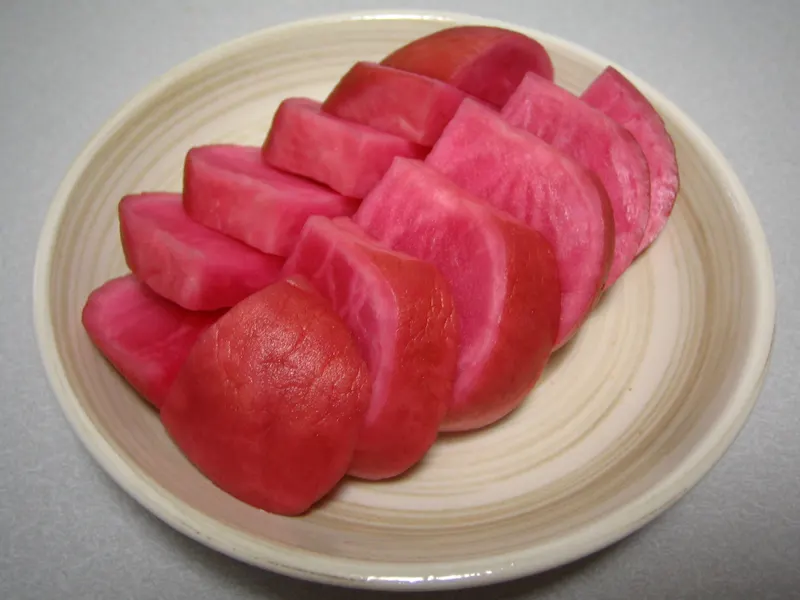
Sanpoku and Atsumi yakihata red turnip pickle赤かぶ漬け
Red turnips grown on burned (yakihata) slopes are salted in brine for a week, drained, and then packed for another week in a sweet vinegar of sanbaizu, sugar and shochu. This is a boundary entry; the sources describe a salt-then-vinegar pickle and do not say that it ferments.
Fully documentedVegetables14 days
Recipe
Photo: ja:User:Haseyu-, Public domain, via Wikimedia Commons
Amounts from a sourceOne pickle container, from the recipe in Niigata no Okazu (Niigata Food Life Improvement Promoters' Council, Kaikōsha) on MAFF's regional cuisine site. Each household has its own cut, seasoning and timing.
none; MAFF describes the pickle as salted, then soaked in a vinegar seasoning (sanbaizu, sugar, shochu)
Total time across the recorded steps: 14 days
Start
Drag the bar or press Play
What changes:Starting material: red turnips grown on burned slopes
Step 1 of 4
Grow the turnips on burned slopes and pick in November
Time
Not documented
Temperature
Not documented
Salt
None given
Acidity
Not documented
The slope is burned in mid-August and the seed sown there. Sanpoku, Atsumi and Shiiba (Miyazaki) are the only places in Japan still farming this way, MAFF says. Output: red turnips with flattened round roots, red-purple outside and white inside.
Flavour
Not documented
Texture
Not documented
Colour
Not documented
Microbes at work in this step
Not documented for this step.
Method
Measured measured in a studySet fixed by a specification or tested recipeReported one source reports itTypical a general value, not sourced for this fermentUnconfirmed not yet checked against a source
At a glance
Red turnips grown on burned (yakihata) slopes are salted in brine for a week, drained, and then packed for another week in a sweet vinegar of sanbaizu, sugar and shochu. This is a boundary entry; the sources describe a salt-then-vinegar pickle and do not say that it ferments. Made in 4 steps over 14 days. The longest step, pre-pickle in salt water, takes 7 days (MAFF うちの郷土料理 (Our Regional Cuisines) 2026).
Unlike Hida akakabu-zuke, which is soured by lactic fermentation in salt alone, this pickle gets its sourness from vinegar after a week in brine. Its colour comes from the turnips grown on burned slopes, which are said not to colour as well elsewhere.
Aba-zuke (Atsumi)An older miso pickle of Atsumi turnips with Shōnai persimmon, wild grape skins, rice bran and salt, now being revived.
Safety
In a study of senmaizuke, a related Kyoto turnip pickle in sweet vinegar, the finished vinegar-type pickles had a pH of 4 to 5. Yeasts such as Kazachstania grew in them, and the author suggests that spoilage by yeast may be a greater risk in the vinegar type, and greater still when stored warmer (Iguchi 2021).
Atsumi turnips have been grown since the Edo period, and pickles of them were presented to the shogun (Japanese Wikipedia). A Yamagata Prefecture leaflet says the Atsumi turnip appears in Edo-period documents and has a history of over 400 years, and that in sweet vinegar its red-purple colour seeps into the flesh and turns it pink. Yakihata farming survives only in Sanpoku, Atsumi and Shiiba (Miyazaki) (MAFF).
Temperature, salt and pH
The sources we found give no temperature, salt or pH figure for any of its steps.