Side-by-side or overlay PDF diff driven by one engine that reads each file into a structured model — text, vector geometry, images, form fields, annotations — and compares the models. Moves show as moves, edits show only where they happened, and any PDF type works without picking a mode.
Open a STEP / STP part and it measures itself — volume, thinnest wall, draft and undercut checks on load, plus hole detection with a BOM. Measure, section, export STL. Rust + WASM B-rep kernel, runs in your browser.
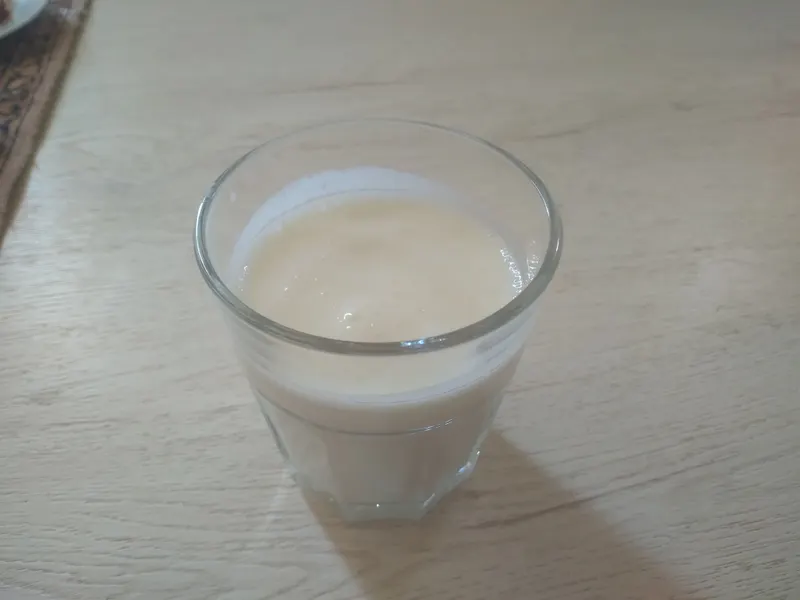
Raw cow or buffalo milk is left undisturbed in a pot until its own bacteria curdle it and the cream rises. The cream is skimmed for butter, and the soured curd below is laban rayeb, eaten as it is or drained into karish cheese.
No fixed amounts recordedHousehold practice with no fixed amounts. The milk is left in its pot until it curdles.
Raw cow or buffalo milk
Nothing is added; the milk's own bacteria sour it[afr26][wp]
The milk's own bacteria, with no starter added
Wikipedia says the milk is left undisturbed while its natural microflora ferments it[wp]
Starter
spontaneous
Total time across the recorded steps: 18 h
Start
Drag the bar or press Play
What changes:A new clay pot is soaked in oil and baked so that its pores close
Step 1 of 4
Prepare the earthenware pot
Time
Not documented
Temperature
Not documented
Salt
None given
Acidity
Not documented
Which microbes the steps name, step by step
Lactic acid bacteria
Wikipedia, citing Robinson and Tamime (1991), says the inside of a new pot is soaked in oil, or in egg white mixed with oil, and baked in a kiln to close the pores. After each use the pot is washed and dried in a hot oven for two hours. Output: a pot with its pores closed.
Flavour
Not documented
Texture
Not documented
Colour
Not documented
Microbes at work in this step
Not documented for this step.
Method
Measured measured in a studySet fixed by a specification or tested recipeReported one source reports itTypical a general value, not sourced for this fermentUnconfirmed not yet checked against a source
At a glance
Raw cow or buffalo milk is left undisturbed in a pot until its own bacteria curdle it and the cream rises. The cream is skimmed for butter, and the soured curd below is laban rayeb, eaten as it is or drained into karish cheese. Made in 4 steps over 18 h. The longest step, leave undisturbed until it curdles, takes 18 h (Samet-Bali O. and Attia H. 2012) and runs at 23–27 °C (Samet-Bali O. and Attia H. 2012). Streptococcus thermophilus, Lactobacillus bulgaricus, L. helveticus, L. acidophilus, L. cremoris and Lactic cocci isolated from Delta rayeb: Enterococcus faecium, E. durans, E. faecalis, E. hirae, Pediococcus acidilactici and Streptococcus infantarius do most of the fermenting.
Laban rayeb is left completely still and gets no starter, unlike zabadi yoghurt, which is heated and seeded. Its curd, drained on a reed mat, becomes karish cheese.
In Tunisia, Samet-Bali and Attia (2012) describe rayeb as a curdled milk known and appreciated for centuries, now also made industrially, though consumers prefer the traditional product for its fresh taste and aroma.