Side-by-side or overlay PDF diff driven by one engine that reads each file into a structured model — text, vector geometry, images, form fields, annotations — and compares the models. Moves show as moves, edits show only where they happened, and any PDF type works without picking a mode.
Open a STEP / STP part and it measures itself — volume, thinnest wall, draft and undercut checks on load, plus hole detection with a BOM. Measure, section, export STL. Rust + WASM B-rep kernel, runs in your browser.
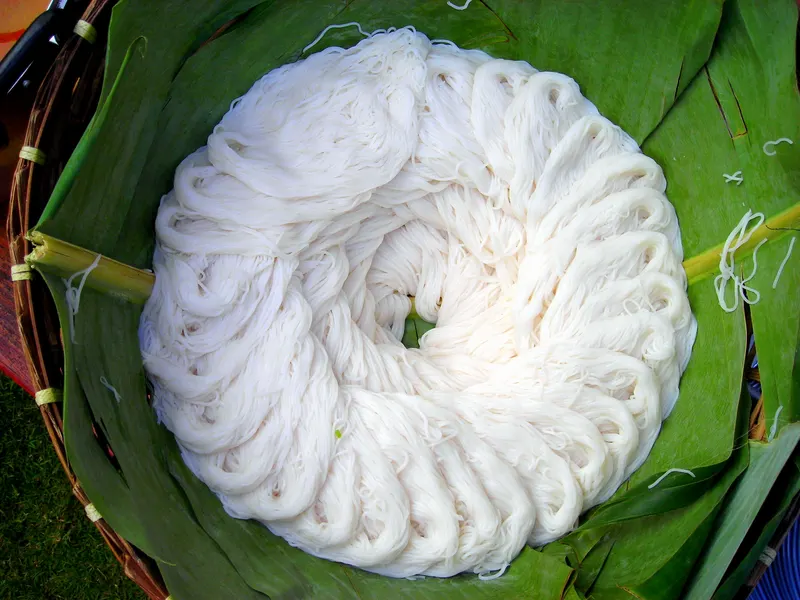
Indica rice is soaked, left wet in a draining container to sour, then wet-milled and settled for days under 2 % salt water. The sour flour is pressed dry, part-cooked, kneaded and pressed out into boiling water as thin round noodles, sold fresh as wads that look like birds' nests.
Fully documentedCereals and bread5 days – 6 days
Recipe
Photo: User:Mattes, Public domain, via Wikimedia Commons
Amounts from a sourceTraditional process with no fixed batch size or recipe amounts in the sources used here. Some noodle makers buy fermented rice flour from flour producers instead of fermenting their own; in one Bangkok-area case study a factory made about 6,600 kg of flour a day and sold most of it.
Rice
Indica rice; the daily rice of one Bangkok-area flour and noodle factory included broken rice[shompoosang2022][kusano2021]
Salt water2 %
The milled rice settles under it for two to three days; the water is changed daily[jircas-kj]
Total time across the recorded steps: 5 days – 6 days
Start
Drag the bar or press Play
What changes:Rice soaks overnight and is drained in a sieve
Step 1 of 7
Soak the rice
Time
Overnight
Reported
Temperature
Not documented
Salt
None given
Acidity
Not documented
Which microbes the steps name, step by step
Lactic acid bacteria
Lactobacillus
Streptococcus
Lactococcus lactis
Leuconostoc
Output: soaked rice, drained in a sieve container.
Flavour
Not documented
Texture
Not documented
Colour
Not documented
Microbes at work in this step
Not documented for this step.
Method
Measured measured in a studySet fixed by a specification or tested recipeReported one source reports itTypical a general value, not sourced for this fermentUnconfirmed not yet checked against a source
At a glance
Indica rice is soaked, left wet in a draining container to sour, then wet-milled and settled for days under 2 % salt water. The sour flour is pressed dry, part-cooked, kneaded and pressed out into boiling water as thin round noodles, sold fresh as wads that look like birds' nests. Made in 7 steps over 5 days – 6 days. The longest step, sour the wet rice (solid-state fermentation), takes at least 3 days (Haard N.F 1999). Salt is 2 % (JIRCAS). Lactobacillus and Streptococcus species in the acid fermentation of the soaked rice and Lactococcus lactis, Leuconostoc (L. citreum, L. lactis, L. pseudomesenteroides), Limosilactobacillus fermentum, Lactiplantibacillus plantarum, L. pentosus, Weissella confusa, Enterococcus faecium do most of the fermenting.
Khanom chin has two fermentations. The wet rice sours in a draining container, and the milled rice then settles for days under 2 % salt water. The salt-water settling stage sets it apart from Cambodian num banhchok, which is soured as pressed flour cakes in cloth bags.
Bought fermented flourSome noodle makers buy fermented rice flour from flour producers, which trade it on the market, instead of fermenting their own (Kusano 2021, one Bangkok-area case study).
Submerged-only fermentationSome producers have replaced the solid-state rice fermentation with submerged fermentation, expecting softer, whiter noodles; in a lab comparison the noodles were 60 % as hard as traditional ones.
Fresh-flour khanom chinMade with fresh flour, without the long rice fermentation; Wikipedia says the noodles are bigger and softer than fermented-flour ones, but gives no source.
Safety
Noodles kept acidic (extract pH around 4.0 or lower) did not liquefy, while noodles brought to pH 6.0 or 8.0 were broken down by starch-digesting bacteria within a few days at 37 °C. Producers are advised to check the pH of the washing water, which can be alkaline. JIRCAS says the noodles should be eaten within a few days of being made.
Hazards the sources name: Cronobacter malonaticus and Acinetobacter baumannii (listed among isolates).
Although chin means "Chinese" in Thai, the noodle is credited to the Mon, and the name is thought to come from the Mon words hanom cin, "boiled noodles". A 2021 study describes khanom jeen producers as small-scale businesses near local markets across Thailand.