Side-by-side or overlay PDF diff driven by one engine that reads each file into a structured model — text, vector geometry, images, form fields, annotations — and compares the models. Moves show as moves, edits show only where they happened, and any PDF type works without picking a mode.
Open a STEP / STP part and it measures itself — volume, thinnest wall, draft and undercut checks on load, plus hole detection with a BOM. Measure, section, export STL. Rust + WASM B-rep kernel, runs in your browser.
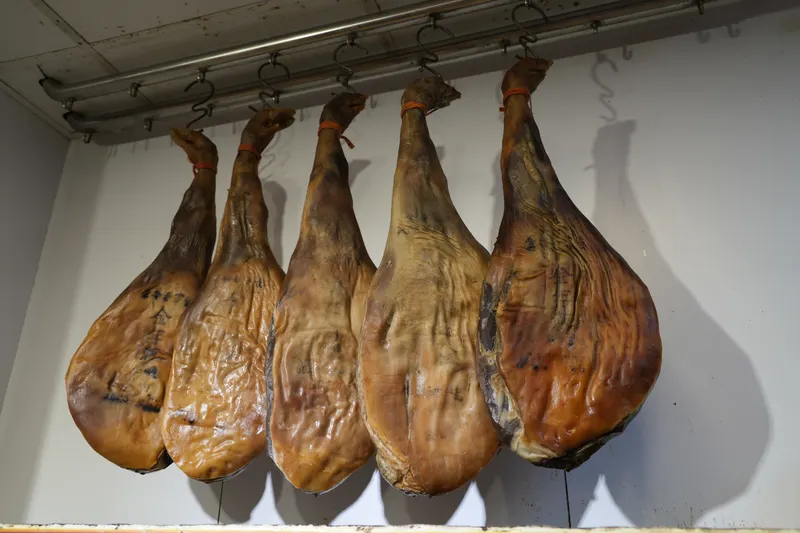
Pork hind legs are rubbed with sea salt six times over about a month in winter, soaked, scrubbed and sun-dried, then hung in airy upper-floor rooms from spring into summer while white and green moulds spread over the meat. The hams are then stacked to post-ripen; the whole cycle takes 7–10 months.
Amounts from a sourceAmounts are per 10 kg of trimmed legs in the Jinhua Ham Industry Association's traditional processing standard (T/JHHTA 0001-2019).
Trimmed fresh pork hind legs, each over 6.0 kg10 kg
Thin skin, small trotter, lean, back fat over the sacrum no thicker than 3.5 cm[jhhta2019]
Coarse, dry sea salt with no anti-caking agentAbout 1000 g, no more than about 1200 g
Applied in six rounds of about 200, 500, 200 and 50 g, then small top-ups[jhhta2019]
Nitrate or nitrite (optional)
Within the national additive standard GB 2760; added at the second salting[jhhta2019]
Starter
spontaneous (Mao and colleagues call the Chinese traditional fermented meats they review, Jinhua ham included, spontaneously fermented)
Total time across the recorded steps: 32 days – 34 days
Start
Drag the bar or press Play
What changes:The leg is trimmed to a bamboo-leaf shape and blood is pressed from its vessels
Step 1 of 6
Trim the leg into a bamboo-leaf shape
Time
Not documented
Temperature
Not documented
Salt
None given
Acidity
Not documented
Which microbes the steps name, step by step
Moulds
Aspergillus
Saccharomyces
Hair, blood and loose fat are scraped off, the pelvic bones are cut back and the flesh side is trimmed smooth. Output: trimmed leg with blood pressed out of the vessels.
Flavour
Not documented
Texture
Not documented
Colour
Not documented
Microbes at work in this step
Not documented for this step.
Method
Measured measured in a studySet fixed by a specification or tested recipeReported one source reports itTypical a general value, not sourced for this fermentUnconfirmed not yet checked against a source
At a glance
Pork hind legs are rubbed with sea salt six times over about a month in winter, soaked, scrubbed and sun-dried, then hung in airy upper-floor rooms from spring into summer while white and green moulds spread over the meat. The hams are then stacked to post-ripen; the whole cycle takes 7–10 months. Made in 6 steps over 32 days – 34 days. The longest step, salt six times and stack, takes at least 27 days (Jinhua Ham Industry Association 2019) and runs at 0–15 °C (Jinhua Ham Industry Association 2019). Salt is 10–12 % (Jinhua Ham Industry Association 2019). Surface moulds that start as small white spots and turn green as they spread and Aspergillus, Saccharomyces, Staphylococcus and Cobetia do most of the fermenting.
Jinhua ham is salted only in winter with heavy sea salt (about 10 %), sun-dried, and then ripened through spring and summer in upstairs rooms open to the weather, where moulds cover it.
Xuanwei ham and Nuodeng ham (Yunnan)Mao and colleagues call Jinhua one of China's top three traditional hams and describe Xuanwei and Nuodeng ham from Yunnan as also very popular, helped by low temperatures and sufficient sunlight.
Safety
The standard limits salting to the cold season, 0–15 °C, and needs about 10 % salt. Nitrate and nitrite, if used, must stay within the national additive standard. Drying rooms must be checked for fly larvae, cheese skippers and beetles. The process has no cooking step, and CDC says curing, drying or smoking alone does not consistently kill Trichinella worms in pork. This page describes a trade standard; it is not a tested home recipe.
Hazards the sources name: Bacillus cereus and Enterococcus faecalis (main spoilage bacteria, with an Enterobacteriaceae strain); Ham pests (cheese-skipper larvae, maggots and Dermestes beetles) in the drying rooms.
Wikipedia gives the Tang dynasty (618–907) as the earliest recorded mention of the processing technique. China's quality inspection authority approved Jinhua ham as a protected origin product in 2002 (announcement no. 84).