Side-by-side or overlay PDF diff driven by one engine that reads each file into a structured model — text, vector geometry, images, form fields, annotations — and compares the models. Moves show as moves, edits show only where they happened, and any PDF type works without picking a mode.
Open a STEP / STP part and it measures itself — volume, thinnest wall, draft and undercut checks on load, plus hole detection with a BOM. Measure, section, export STL. Rust + WASM B-rep kernel, runs in your browser.
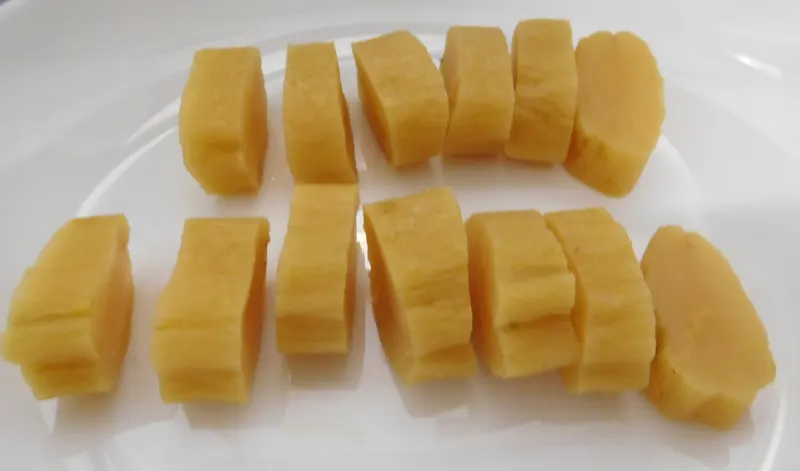
Ise takuan is made from Misono daikon, a long white-necked radish bred for takuan in Mie. The roots hang on racks in sun and winter wind for one to two weeks, then are packed in a barrel with rice bran and salt under a weight. Lactic acid bacteria ferment the barrel for months and often for two years or more.
No fixed amounts recordedNo tested recipe with weights was found. The sources give the method and the drying and ageing times, and one source gives the salt level.
About 10 % in the Japanese Wikipedia description; no weight given by MAFF[jawiki-ise][maff-ise]
Persimmon peel, eggplant leaves, chilli, kombu, sometimes turmeric
Optional seasonings and colouring; MAFF says no synthetic seasoning, colouring or preservative is used[maff-ise][mie-brand]
Starter
spontaneous
Total time across the recorded steps: 3 years
Start
Drag the bar or press Play
What changes:Daikon hang on hasa racks for 1–2 weeks in sun and wind until they bend
Step 1 of 4
Hang daikon on hasa racks in the Ise plain
Time
7–14 days
Reported
Temperature
Not documented
Salt
None given
Acidity
Not documented
Flavour
Not documented
Texture
dried until it can be bent into the kana letter 'no'
Colour
Not documented
Microbes at work in this step
Not documented for this step.
Method
Measured measured in a studySet fixed by a specification or tested recipeReported one source reports itTypical a general value, not sourced for this fermentUnconfirmed not yet checked against a source
At a glance
Ise takuan is made from Misono daikon, a long white-necked radish bred for takuan in Mie. The roots hang on racks in sun and winter wind for one to two weeks, then are packed in a barrel with rice bran and salt under a weight. Lactic acid bacteria ferment the barrel for months and often for two years or more. Made in 4 steps over 3 years. The longest step, lactic fermentation, takes up to 3 years (MAFF にっぽん伝統食図鑑 (Traditional Foods of Japan) 2026). Salt is 10 % (Japanese Wikipedia 2026).
Dried in the wind of the Ise plain and aged for months to two years or more. The roots are one named variety, Misono daikon, and the name is a regional collective trademark.
The barrel is salted at around 10 % and fermented by lactic acid bacteria for about two years (Japanese Wikipedia). MAFF says no synthetic seasoning, colouring or preservative is used.
Begun in late Edo in Misono (Ise) with surplus daikon; sold by farm women in Osaka and Kyoto from Meiji; 300,000 barrels in 1943; 150,000 in 1950. Post-war barrels were sweetened with saccharin and dulcin and coloured with turmeric and tartrazine (auramine before 1947).