Side-by-side or overlay PDF diff driven by one engine that reads each file into a structured model — text, vector geometry, images, form fields, annotations — and compares the models. Moves show as moves, edits show only where they happened, and any PDF type works without picking a mode.
Open a STEP / STP part and it measures itself — volume, thinnest wall, draft and undercut checks on load, plus hole detection with a BOM. Measure, section, export STL. Rust + WASM B-rep kernel, runs in your browser.
Cheese from France, Savoie, Haute-Savoie, Ain, Jura, Doubs, Haute-Saône, Côte-d'Or, Haute-Marne and nearby
Gruyère (French IGP)Gruyère
Raw cow milk is seeded with whey starters or natural rennet made on recuite and set with calf rennet in an open copper vat. The curd is cooked to 52 °C or more, pressed, salted and pre-ripened cool; a stay in a warm cellar above 15 °C then lets propionic bacteria form pea- to cherry-sized eyes. It ripens at least 120 days.
As brine or dry salt, then salt water and morge on the rind[cdc-gru2026]
Starter
natural whey starters and/or natural rennet made on recuite, which bring at least thermophilic lactobacilli; selected cultures are also allowed
Total time across the recorded steps: 4.4 months
Start
Drag the bar or press Play
What changes:Starting material: raw cow milk, never heated above 40 °C
Step 1 of 8
Prepare the raw milk
Time
Not documented
Temperature
up to 40 °C
Set
Salt
None given
Acidity
Not documented
Which microbes the steps name, step by step
Lactobacilli
Pasteurisers, bactofugation and microfiltration are banned. Output: raw milk in the vat.
Flavour
Not documented
Texture
Not documented
Colour
white
Microbes at work in this step
Not documented for this step.
Method
Measured measured in a studySet fixed by a specification or tested recipeReported one source reports itTypical a general value, not sourced for this fermentUnconfirmed not yet checked against a source
At a glance
Raw cow milk is seeded with whey starters or natural rennet made on recuite and set with calf rennet in an open copper vat. The curd is cooked to 52 °C or more, pressed, salted and pre-ripened cool; a stay in a warm cellar above 15 °C then lets propionic bacteria form pea- to cherry-sized eyes. It ripens at least 120 days. Made in 8 steps over 4.4 months. The longest step, ripen to at least 120 days, takes at least 3.9 months (Ministère de l'agriculture 2026) and runs at at least 4 °C (Ministère de l'agriculture 2026). Thermophilic and mesophilic lactobacilli and thermophilic streptococci and Propionic bacteria do most of the fermenting.
Unlike Swiss Le Gruyère AOP, the French IGP must have pea- to cherry-size eyes from a warm-cellar propionic stage. Its milk is seeded with natural whey starters or natural rennet on recuite, which bring at least thermophilic lactobacilli; selected cultures are also allowed.
Rind
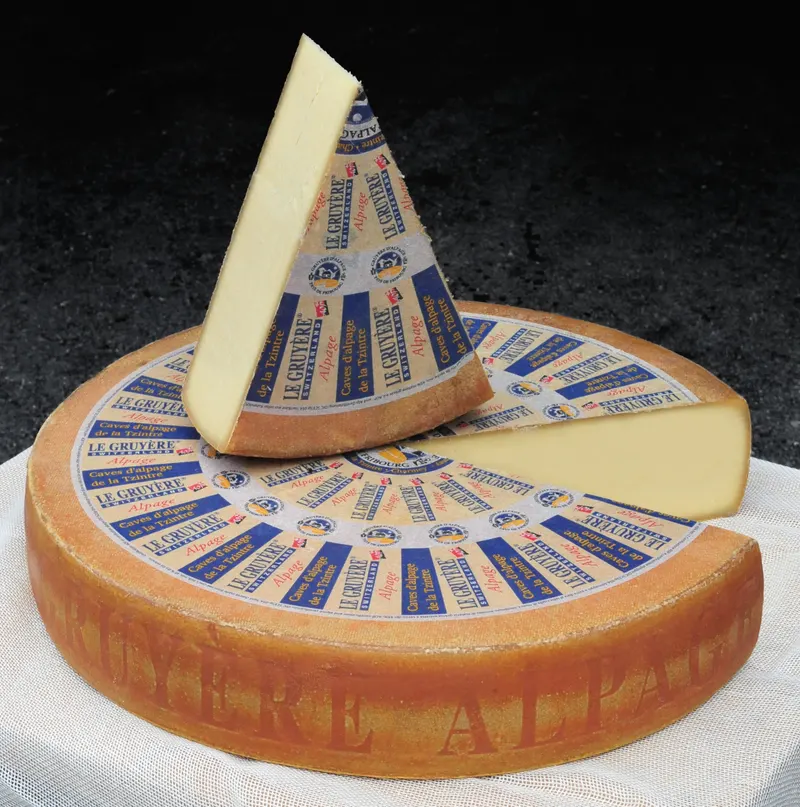
Rubbed, solid, grainy, golden to brown
Size
53–63 cm diameter, 13–16 cm high
Composition
IGP rules: 47–52 % fat in dry matter, at least 62 % dry matter, 0.6–1.7 g salt per 100 g
The cheese is made from raw milk. The specification bars any heat treatment of the milk above 40 °C, caps collection at two consecutive milkings, sets renneting by noon or midnight depending on the oldest milking, cooks the curd and whey to at least 52 °C and ripens at least 120 days after renneting; it also bans silage and other fermented forage. It gives these as production rules and sets no microbiological criteria. ANSES names Listeria monocytogenes, Salmonella and enterohaemorrhagic E. coli as hazards of raw-milk cheeses, and soft bloomy-rind and short-ripened uncooked pressed cheeses as the main sources. It advises pregnant women, people with weak immunity, people over 65 and young children to avoid raw-milk cheeses except cooked pressed ones such as gruyère or comté.
The specification calls it one of the oldest French cheeses, made for several centuries in the east-central region bordering Switzerland, and says its name refers to the gruyers, officers who collected taxes on the mountain's timber. By the end of the 19th century its traditional zone matched the area of the fruitière system, in which milk producers pool milk in a cooperative dairy and hire the cheesemaker. Commission Implementing Regulation (EU) No 110/2013 of 6 February 2013 entered the name as a PGI for France over objections from Australia, New Zealand and US dairy bodies, who called it generic; the Commission treated it as a traditional name and required 'France' on the label next to it. The present specification was homologated by arrêté of 23 July 2026.