Side-by-side or overlay PDF diff driven by one engine that reads each file into a structured model — text, vector geometry, images, form fields, annotations — and compares the models. Moves show as moves, edits show only where they happened, and any PDF type works without picking a mode.
Open a STEP / STP part and it measures itself — volume, thinnest wall, draft and undercut checks on load, plus hole detection with a BOM. Measure, section, export STL. Rust + WASM B-rep kernel, runs in your browser.
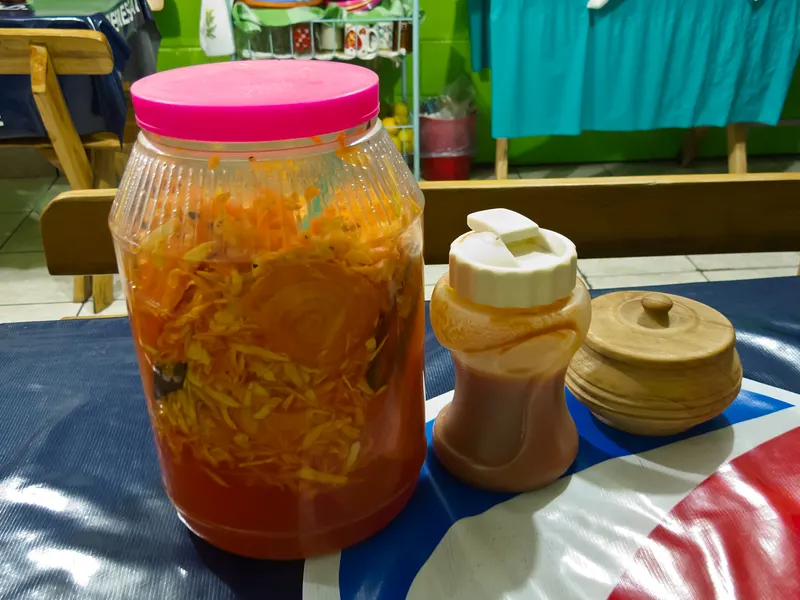
Shredded cabbage, carrot and onion are salted, seasoned with oregano and chilli, packed under their own brine and left to sour for a few days to two weeks. It is the slaw served with pupusas; a quick vinegar version that is not fermented also exists.
Amounts from a sourceA half-gallon jar from Kirsten and Christopher Shockey's book Fermented Vegetables. The University of Illinois Extension recipe is the unfermented vinegar version.
Start with 1 Tbsp and add a teaspoon more if needed[shockey2014]
Total time across the recorded steps: 4 days – 14 days
Start
Drag the bar or press Play
What changes:A cut line slices the cored cabbage into thin shreds
Step 1 of 6
Shred the cabbage and slice the carrot and onion
Time
Not documented
Temperature
Not documented
Salt
None given
Acidity
Not documented
Set aside a few clean outer leaves to cover the jar later. Output: shredded vegetables.
Flavour
Not documented
Texture
Not documented
Colour
Not documented
Microbes at work in this step
Not documented for this step.
Method
Measured measured in a studySet fixed by a specification or tested recipeReported one source reports itTypical a general value, not sourced for this fermentUnconfirmed not yet checked against a source
At a glance
Shredded cabbage, carrot and onion are salted, seasoned with oregano and chilli, packed under their own brine and left to sour for a few days to two weeks. It is the slaw served with pupusas; a quick vinegar version that is not fermented also exists. Made in 6 steps over 4 days – 14 days. The longest step, ferment at cool room temperature, takes 4–14 days (Shockey K. and Shockey C. 2014).
Curtido ferments like sauerkraut but with carrot, onion, garlic, oregano and chilli in the jar. A quick version skips fermenting and dresses blanched cabbage with vinegar instead.
Vinegar curtidoCabbage blanched for 1 minute, then mixed with carrot, onion, oregano, salt, brown sugar, vinegar and water and chilled at least 2 hours; not fermented.
Safety
Fermented curtido follows the rules for any fermented vegetable. Keep it under brine and away from air, and check that the pH falls steadily below 4.6, the critical limit that holds back Clostridium botulinum. Discard a batch that does not get there. More than 2 % salt is an important safety factor, and this recipe gives salt only by the spoon, so weigh it. Fermentation is what kills pathogenic E. coli. In a sauerkraut study pathogens fell 5 log (100,000-fold) in the first 4 days at 18–22 °C. But E. coli can survive up to 2 weeks in commercial fermentation brine at 20 °C and a month or longer in acidified brine at 4 °C, so let the ferment finish, then refrigerate it (Snyder et al.). The quick vinegar version is not fermented and goes into the refrigerator from the start.
Hazards the sources name: Escherichia coli O157:H7 in traditionally fermented vegetables, not tested in curtido; it can survive up to 2 weeks in commercial fermentation brine at 20 °C; Clostridium botulinum in traditionally fermented vegetables, not tested in curtido; held back once the pH is below 4.6.