Side-by-side or overlay PDF diff driven by one engine that reads each file into a structured model — text, vector geometry, images, form fields, annotations — and compares the models. Moves show as moves, edits show only where they happened, and any PDF type works without picking a mode.
Open a STEP / STP part and it measures itself — volume, thinnest wall, draft and undercut checks on load, plus hole detection with a BOM. Measure, section, export STL. Rust + WASM B-rep kernel, runs in your browser.
Cocoa, coffee and spice from About 70 coffee-growing countries across Latin America, Asia and Africa
Coffee fermentation and processing
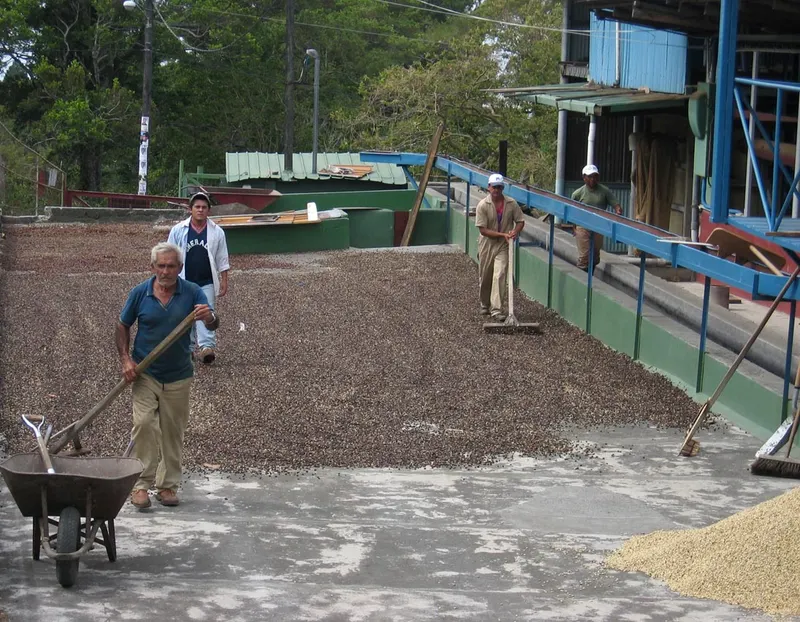
After harvest, coffee fruit is fermented by its own yeasts and bacteria before it is dried, either inside the whole cherry (natural or dry process) or as pulped beans in a tank (washed process). The steps here follow the natural process; the cherries ferment as they lose water, and they must reach below 12.5 % moisture quickly to keep out the moulds that make ochratoxin A.
Fully documentedCocoa, coffee and spice11 days – 14 days
No fixed amounts recordedFarm process with no fixed batch; drying layers of 3 to 5 cm hold about 25 to 35 kg of fruit per square metre.
Ripe coffee cherries
Sorted to remove unripe, overripe and diseased fruit, by hand or by floating in water[codex-ota]
No additions
Natural fermentation uses the fruit's own microbes; trials have added yeast starters or sealed the fruit under CO2[moncayo2025][silva2008]
Starter
spontaneous, from the fruit's own microbes
Total time across the recorded steps: 11 days – 14 days
Start
Drag the bar or press Play
What changes:Starting material: ripe red coffee cherries, sorted from green and overripe ones
Step 1 of 5
Pick and sort ripe cherries
Time
Not documented
Temperature
Not documented
Salt
None given
Acidity
Not documented
Which microbes the steps name, step by step
Yeasts
Aspergillus
Cherries should be dried the same day they are picked; holding fruit in bags or heaps for up to a week heats it and starts a quick ferment that raises the ochratoxin risk.
Flavour
Not documented
Texture
Not documented
Colour
Not documented
Microbes at work in this step
Not documented for this step.
Method
Measured measured in a studySet fixed by a specification or tested recipeReported one source reports itTypical a general value, not sourced for this fermentUnconfirmed not yet checked against a source
At a glance
After harvest, coffee fruit is fermented by its own yeasts and bacteria before it is dried, either inside the whole cherry (natural or dry process) or as pulped beans in a tank (washed process). The steps here follow the natural process; the cherries ferment as they lose water, and they must reach below 12.5 % moisture quickly to keep out the moulds that make ochratoxin A. Made in 5 steps over 11 days – 14 days. The longest step, dry quickly to safe moisture, takes 8.9 days (Moncayo-Palacios M.F. et al. 2025) and runs at 24–42 °C (Moncayo-Palacios M.F. et al. 2025). Yeasts Debaryomyces, Pichia and Candida, which become more common as the fruit dries and Bacillus and other Gram-positive bacteria, most numerous at the start of natural processing do most of the fermenting.
In the natural process the beans ferment inside the whole, drying fruit, so the pulp's sugars and microbes act on the bean for days. In the washed process the fruit is pulped first and only the mucilage ferments, for 12 to 36 hours in a tank, before washing and drying.
Washed (wet) processThe cherry is pulped and the mucilage-coated beans ferment in tanks for 12 to 36 hours, then are washed and dried; see the coffee wet-process entry.
Honey or pulped naturalThe skin is removed but some or all of the mucilage is left on the beans as they dry.
Self-induced anaerobic fermentationWhole fruit or pulped beans are fermented in a static closed tank fitted with an airlock, which lets the CO2 the microbes make escape and keeps air out; see the SIAF entry.
Carbonic maceration and CO2-sealed naturalsWhole cherries are held under added CO2 before drying, a method borrowed from wine.
Monsooned MalabarDried coffee is exposed to monsoon air in India; an ageing process rather than a ferment.
Safety
Codex links ochratoxin A in coffee to slow drying. Dry cherries the day they are picked, keep the time in the risky water-activity range to 5 days or less, and bring the beans below 12.5 % moisture (water activity 0.67 to 0.70) before storage.
Hazards the sources name: Ochratoxin A from Aspergillus ochraceus and related species, A. niger and A. carbonarius.
Codex describes two basic systems, the dry process that gives natural coffee and the wet process that gives washed coffee. A 2025 trial compared open-air and CO2-sealed fermentation of natural coffee cherries for their effect on flavour.