Side-by-side or overlay PDF diff driven by one engine that reads each file into a structured model — text, vector geometry, images, form fields, annotations — and compares the models. Moves show as moves, edits show only where they happened, and any PDF type works without picking a mode.
Open a STEP / STP part and it measures itself — volume, thinnest wall, draft and undercut checks on load, plus hole detection with a BOM. Measure, section, export STL. Rust + WASM B-rep kernel, runs in your browser.
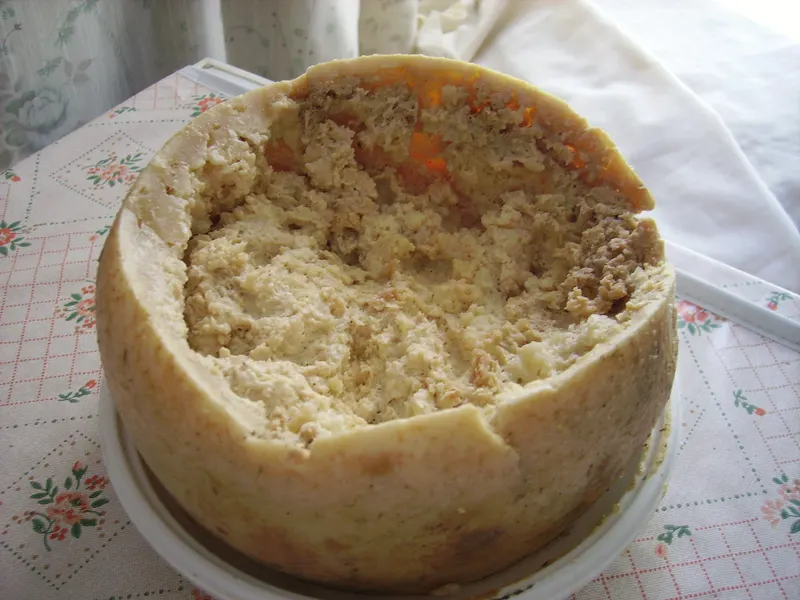
A Sardinian pecorino, mostly from sheep milk, is left open to the cheese fly Piophila casei in the warm months. The fly lays eggs in cracks in the rind, and the larvae feed on the paste, breaking down protein and fat until it turns soft and pungent; the cheese is ready after 60–90 days. It is listed as a Sardinian traditional product, but a 2020 review calls it one of the most disputable cheeses in Europe for safety, and its production has stayed informal.
Fully documentedCheese2 months – 3 monthsTraditional food product (PAT, Regione Sardegna, D.M. 18 July 2000 and later lists)
No fixed amounts recordedNo fixed recipe. The controlled-production study made about 250 L of whole sheep milk into each batch of cheese, salted in 20 °Bé brine for 12 or 24 hours.
A young pecorino, made from raw or (in the study) pasteurised whole sheep milk
in the controlled study, a freeze-dried lactic culture and calf rennet in the base cheese (plus a Saccharomyces cerevisiae yeast culture in the holed-paste cheese); Piophila casei larvae then colonise it
Total time across the recorded steps: 2 months – 3 months
Start
Drag the bar or press Play
What changes:A young pecorino is made, lightly salted so the fly can reach it
Step 1 of 4
Make a young pecorino
Time
Not documented
Temperature
Not documented
Salt
None given
Acidity
Not documented
Producers make colonisation easier by brining less, pressing less, piercing the rind and using oil on it.
Flavour
Not documented
Texture
Not documented
Colour
Not documented
Microbes at work in this step
Not documented for this step.
Method
Measured measured in a studySet fixed by a specification or tested recipeReported one source reports itTypical a general value, not sourced for this fermentUnconfirmed not yet checked against a source
At a glance
A Sardinian pecorino, mostly from sheep milk, is left open to the cheese fly Piophila casei in the warm months. The fly lays eggs in cracks in the rind, and the larvae feed on the paste, breaking down protein and fat until it turns soft and pungent; the cheese is ready after 60–90 days. It is listed as a Sardinian traditional product, but a 2020 review calls it one of the most disputable cheeses in Europe for safety, and its production has stayed informal. Made in 4 steps over 2 months – 3 months. The longest step, larvae digest the paste, takes 2–3 months (Manca G 2015). Piophila casei larvae does most of the fermenting.
Fly larvae change the paste, partly by chewing and partly by enzymes; similar cheeses are named from Abruzzo, Friuli and Emilia-Romagna. Producers invite the fly on purpose by shortening the brining, pressing less, piercing or oiling the rind and keeping the cheese in the warmest rooms.
Legal status
On the Sardinian list of traditional products since the D.M. of 18 July 2000; EU law bars placing unsafe food on the market (Reg. (EC) No 178/2002, art. 14), and the study notes production is informal (Toti 2020 review; Mazzette 2010)
GABA
Farmhouse casu marzu held 34.4–1001.3 mg GABA per 100 g
Cacio marcetto (Abruzzo)Named in the controlled-production study as a similar larva-ripened cheese from Abruzzo
Salterello (Friuli) and furmai nis (Emilia-Romagna)Similar larva-ripened cheeses named in the controlled-production study
Safety
In the controlled study, pH above 5.6 and water activity above 0.920 from 30 days on did not stop spoilage bacteria, and Bacillus cereus group and Clostridium perfringens turned up in a few samples. The authors advise it only for healthy adults. The larvae have been linked to intestinal myiasis, and strong proteolysis gives high biogenic amines. It is eaten with live larvae, so this page records a tradition, not a method to copy at home.
Hazards the sources name: Bacillus cereus group strains (sporadic, mostly early in the process) and Clostridium perfringens on the rind of two 60-day cheeses, one exposed to the fly and one protected control, in the controlled-production study; Live Piophila casei larvae, linked to gastrointestinal myiasis in people; High biogenic amines from strong proteolysis.
Mazzette and colleagues (2010) say producers and industrial dairies promoted a valorisation project, funded by Regione Sardegna, to win recognition for casu marzu. It first characterised farm-made cheeses, then tried colonisation under controlled conditions with flies reared in the laboratory.