Side-by-side or overlay PDF diff driven by one engine that reads each file into a structured model — text, vector geometry, images, form fields, annotations — and compares the models. Moves show as moves, edits show only where they happened, and any PDF type works without picking a mode.
Open a STEP / STP part and it measures itself — volume, thinnest wall, draft and undercut checks on load, plus hole detection with a BOM. Measure, section, export STL. Rust + WASM B-rep kernel, runs in your browser.
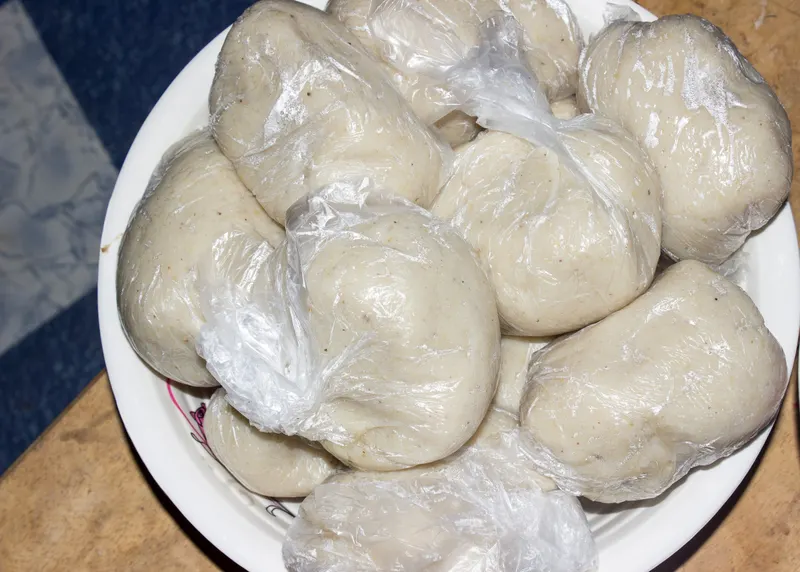
Maize, alone or with cassava, is steeped in water for a day, wet-milled and fermented as a dough for about three days. The dough is mixed with water and cooked with continuous stirring and kneading into a smooth, whitish paste that is formed into balls.
Total time across the recorded steps: 3 days – 6 days
Start
Drag the bar or press Play
What changes:Water soaks into the maize grains and softens them
Step 1 of 4
Steep the maize
Time
24 h
Reported
Temperature
Not documented
Salt
None given
Acidity
Not documented
Which microbes the steps name, step by step
Lactic acid bacteria
Moulds
Output: soft steeped maize.
Flavour
Not documented
Texture
Not documented
Colour
Not documented
Microbes at work in this step
Not documented for this step.
Method
Measured measured in a studySet fixed by a specification or tested recipeReported one source reports itTypical a general value, not sourced for this fermentUnconfirmed not yet checked against a source
At a glance
Maize, alone or with cassava, is steeped in water for a day, wet-milled and fermented as a dough for about three days. The dough is mixed with water and cooked with continuous stirring and kneading into a smooth, whitish paste that is formed into balls. Made in 4 steps over 3 days – 6 days. The longest step, wet-mill and ferment the dough, takes 2–5 days (FAO 1999). Lactic acid bacteria, named by FAO as predominant in the fermentation does most of the fermenting.
Banku and kenkey are both Ghanaian fermented maize doughs. Kenkey is made by cooking part of the dough as aflata, mixing it with the rest, moulding balls, wrapping them and steaming; banku is mixed with water and cooked with stirring and kneading. Cassava dough can be mixed in.
Maize and cassava banku4 parts dough to 1 part fermented cassava dough, with 2 parts water.
Quick-cooking banku (drum-dried)A quick-cooking banku made by drum-drying (Owusu-Ansah et al.), developed from studies of how far banku starch is gelatinised.
Safety
A 2024 study of banku made in Côte d'Ivoire says its preparation is empirical and done in unhygienic conditions. After cooking, mesophilic aerobic bacteria were (5.6 ± 0.4) × 10^3 CFU/g, below the CODINORM standard, and the authors conclude banku can be safely consumed. The abstract gives one count of general bacteria from two localities, which is not proof that every batch is safe. Raw cassava holds toxic cyanide, so banku with cassava dough relies on fermentation to lower it. An FAO overview reports that fermenting cassava roots in water for 3 days cut cyanide by 70–95 %, not all of it. No source we read measures cyanide in banku.
Hazards the sources name: Mesophilic aerobic bacteria (5.6 × 10^3 cfu/g in cooked banku made in Côte d'Ivoire, below the CODINORM standard).
FAO 1999 cites the development of a quick-cooking banku by drum-drying, reported by Owusu Ansah and colleagues in 1988. Krabi and colleagues (2024) describe banku as made by Togolese, Nigerian and Ghanaian communities living in Côte d'Ivoire, where it is little known to the original inhabitants.
Starter
The sources we found do not say how its fermentation begins.
Temperature, salt and pH
The sources we found give no temperature, salt or pH figure for any of its steps.