Side-by-side or overlay PDF diff driven by one engine that reads each file into a structured model — text, vector geometry, images, form fields, annotations — and compares the models. Moves show as moves, edits show only where they happened, and any PDF type works without picking a mode.
Open a STEP / STP part and it measures itself — volume, thinnest wall, draft and undercut checks on load, plus hole detection with a BOM. Measure, section, export STL. Rust + WASM B-rep kernel, runs in your browser.
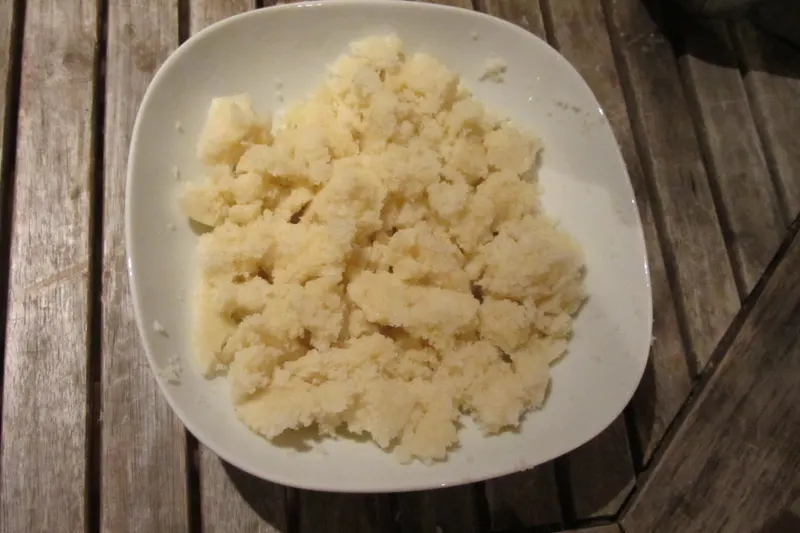
Fresh cassava is grated with about a tenth of its weight of magnan, a starter made from cooked cassava kept in a used jute bag, and left overnight to sour. The pulp is pressed, rubbed into granules, dried and steamed into soft, separate grains like couscous.
Fully documentedRoots and tubers3.5 days – 3.6 days
Amounts from a sourceTraditional process with no fixed batch size. Producers inoculate the grated pulp with about 10 % magnan; the amounts above describe that ratio, not a weighed recipe.
Total time across the recorded steps: 3.5 days – 3.6 days
Start
Drag the bar or press Play
What changes:Cooked cassava sours for three days in an old jute bag and becomes the magnan starter
Step 1 of 7
Make the magnan
Time
3 days
Reported
Temperature
Not documented
Salt
None given
Acidity
pH 5
Measured
Which microbes the steps name, step by step
Lactic acid bacteria
Yeasts
Bacillus cereus
L. mesenteroides
Lactobacillus salivarius
Magnan held aerobic mesophiles at about 8.2 × 10^7 cfu/g, with lactic acid 0.2 % and acetic acid 0.1 %. Output: magnan (starter).
Flavour
Not documented
Texture
Not documented
Colour
Not documented
Microbes at work in this step
the old bag seeds the cooked roots with lactic bacteria and yeasts
Method
Measured measured in a studySet fixed by a specification or tested recipeReported one source reports itTypical a general value, not sourced for this fermentUnconfirmed not yet checked against a source
At a glance
Fresh cassava is grated with about a tenth of its weight of magnan, a starter made from cooked cassava kept in a used jute bag, and left overnight to sour. The pulp is pressed, rubbed into granules, dried and steamed into soft, separate grains like couscous. Made in 7 steps over 3.5 days – 3.6 days. The longest step, make the magnan, takes 3 days (Nimaga D 2012). Leuconostoc mesenteroides and At the end: Lactobacillus salivarius 20 %, L. delbrueckii 16 %, L. fermentum 12 %, L. confusus 10 % of lactic bacteria do most of the fermenting.
Attiéké is started on purpose with magnan, so it sours in about 12 to 15 hours. Gari is made without an inoculum, sours for days and is roasted dry, while attiéké is steamed and stays soft and moist.
Attiéké garbaA lower-quality attiéké with incomplete fermentation, made by shortening the normal process. It is described as a sticky product with a lot of fibre and a more acidic taste.
Safety
Fermentation, pressing and steaming cut hydrocyanic acid (cyanide) from 116 mg/kg in the roots to 3.4 mg/kg in attiéké in one study, below the 10 mg/kg Codex level the authors cite. In that study steaming removed every microbe found except Bacillus cereus spores, which fell to about 10^2 cfu/g, but all of them reappeared right after packaging, though below the Codinorm standard. In another study microbial quality was already unsatisfactory after three days at room temperature, so eat it soon.
Hazards the sources name: Bacillus cereus spores survive steaming (about 10^2 cfu/g); counts of 10^5 cfu/g or more in attiéké garba sold in Daloa; Staphylococcus aureus in intermediate products, reduced during fermentation and pressing; Enterobacter sakazakii (Cronobacter) and Klebsiella pneumoniae carried in with the magnan, cut to under 10^2 cfu/g by the acid at the end of fermentation.
The word attiéké comes from adjèkè in the Ebrié language; Bambara transporters made it atchèkè and French settlers wrote it attiéké (Ouitona). Ebrié women once told apart the adjèkè sold at market from the ahi eaten at home. In 1979 the Société Ivoirienne de Technologie Tropicale (I2T) was created to modernise attiéké production.
[coulin2006] Coulin P., Farah Z., Assanvo J., Spillmann H., Puhan Z. 2006, Characterisation of the microflora of attiéké, a fermented cassava product, during traditional small-scale preparation, Int J Food Microbiol 106:131–136, doi:10.1016/j.ijfoodmicro.2005.06.012paper
[djeni2011] Djeni N.T., N'Guessan K.F., Toka D.M., Kouame K.A., Dje K.M. 2011, Quality of attieke (a fermented cassava product) from the three main processing zones in Côte d'Ivoire, Food Res Int 44:410–416, doi:10.1016/j.foodres.2010.09.032paper
[kouame2020] Kouamé A.K., Bouatenin M.J.K., Djéni T.N., Dje K.M. 2020, Identification of hazards and critical control points during attiéké (a fermented cassava product) process in Côte d'Ivoire, Lett Appl Microbiol 70:87–94, doi:10.1111/lam.13247paper