Side-by-side or overlay PDF diff driven by one engine that reads each file into a structured model — text, vector geometry, images, form fields, annotations — and compares the models. Moves show as moves, edits show only where they happened, and any PDF type works without picking a mode.
Open a STEP / STP part and it measures itself — volume, thinnest wall, draft and undercut checks on load, plus hole detection with a BOM. Measure, section, export STL. Rust + WASM B-rep kernel, runs in your browser.
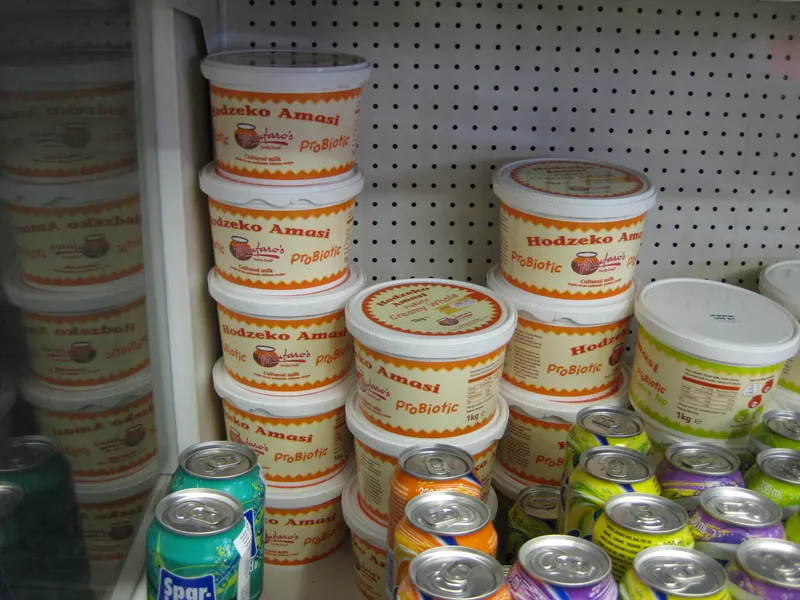
Fermented milk from South Africa, Zimbabwe and Lesotho
Amasi / maasamasi
Amasi is raw cow milk left to sour on its own in a covered calabash, gourd or clay pot until it sets into a thick, sharp curd. In Zimbabwe some of the whey is drained and fresh milk added, which gives the more drained umlaza and mashoronga. Dairies now make it from pasteurised milk with a lactococcal culture.
No fixed amounts recordedHousehold practice with no fixed amounts. Daily surplus milk goes into the vessel; the FAO manual gives times, not quantities.
Raw cow milk
Usually not heated; the milk's own bacteria and the vessel start the souring[fao-tmp-ii]
Starter (none in the traditional method)
FAO says no starters are used. In one study of unpasteurised milk, back-slopping and two starter cultures were tried against natural fermentation; dairies add Lactococcus lactis (Wikipedia)[fao-tmp-ii][gran2003][wp]
Starter
spontaneous; dairies add a Lactococcus lactis culture
Total time across the recorded steps: 4 days – 10 days
Start
Drag the bar or press Play
What changes:Raw milk goes into a calabash or clay pot and is covered
Step 1 of 4
Pour raw milk into a covered vessel
Time
Not documented
Temperature
Not documented
Salt
None given
Acidity
Not documented
Which microbes the steps name, step by step
Lactic acid bacteria
Output: raw milk set aside to sour.
Flavour
Not documented
Texture
liquid
Colour
Not documented
Microbes at work in this step
the milk's own bacteria and those on the vessel walls
Method
Measured measured in a studySet fixed by a specification or tested recipeReported one source reports itTypical a general value, not sourced for this fermentUnconfirmed not yet checked against a source
At a glance
Amasi is raw cow milk left to sour on its own in a covered calabash, gourd or clay pot until it sets into a thick, sharp curd. In Zimbabwe some of the whey is drained and fresh milk added, which gives the more drained umlaza and mashoronga. Dairies now make it from pasteurised milk with a lactococcal culture. Made in 4 steps over 4 days – 10 days. The longest step, drain some whey and top up with fresh milk, takes 3–7 days (FAO 1990). Lactic acid bacteria of the family Lactobacillaceae, most abundant by amplicon sequencing and Lactiplantibacillus plantarum do most of the fermenting.
Amasi is soured raw milk with no added starter and no heating, so the vessel and the milk carry the bacteria. The Zimbabwean drained forms umlaza and mashoronga are concentrated by pouring off whey and adding more milk.
Commercial amasiIn one study, fermented at 30 °C for 24 h and stored at 7 °C.
Umlaza and mashoronga (Zimbabwe)Partly drained sour milks; mashoronga is drained more than umlaza.
Safety
Traditional amasi is made from raw milk, which CDC says can carry Campylobacter, E. coli, Listeria, Brucella and Salmonella. In a challenge study with goat-milk amasi, E. coli O157:H7 could not be detected in the traditional amasi after 3 days, but it was still found at 2.7 log cfu/mL in the commercial amasi, and the authors conclude it can survive fermentation and storage. Fermentation time, pH and storage temperature affect its survival. The challenge study tested only E. coli O157:H7, so it does not show that souring removes the other germs. CDC advises choosing pasteurised milk, and children under 5, adults over 65, pregnant women and people with weak immunity are most at risk.
Hazards the sources name: Escherichia coli, highest after 48 h in the spontaneous and back-slopped batches of one study; Escherichia coli O157:H7 (in a challenge study it was undetectable in traditional goat-milk amasi after 3 days, but still found at 2.7 log cfu/mL in commercial amasi).